



The Woman Behind the Vision: Juliana Gharbin
At the heart of this historic feat is Juliana Gharbin, a bead artist, creative entrepreneur, and cultural advocate whose journey into bead artistry began long before Guinness World Records took notice. Born and raised in Ghana, Juliana grew up surrounded by the rich symbolism of beads—objects deeply embedded in Ghanaian identity, history, and ceremonial life.
In many Ghanaian cultures, beads are not merely decorative. They signify status, rites of passage, spirituality, beauty, femininity, and continuity. From birth ceremonies to puberty rites, royal installations to marriage celebrations, beads carry meaning that transcends generations.
Juliana was drawn to this symbolism early in life. What began as admiration evolved into practice, experimentation, and eventually mastery. Over the years, she refined her skills, blending traditional beadwork techniques with modern artistic sensibilities. Her work became known not only for its precision but also for its storytelling—each piece carrying cultural memory woven into colour, pattern, and form.
Determined to professionalise her craft, Juliana founded Jules Beads, a creative brand dedicated to bead artistry, education, and innovation. What started as a small operation gradually grew into a collective of skilled artisans united by a shared vision: to redefine how bead art is perceived locally and globally.
 Jules Beads: From Craft Studio to Creative Movement

Jules Beads is more than a workshop—it is a creative ecosystem. The team comprises bead makers, designers, planners, coordinators, and apprentices, many of whom were trained internally. Under Juliana’s leadership, the collective has become a space where tradition meets experimentation and where teamwork transforms individual skill into collective excellence.
One of the defining philosophies of Jules Beads is collaboration. Unlike solitary art forms, bead sculpture at monumental scale demands coordination, patience, and unity. Each bead placed is a testament to shared effort.
Over time, the team began to dream bigger—literally.
“We wanted to challenge what people think beads can do,” Juliana has said in interviews. “Beads are often seen as small, delicate items. We wanted to show that they can also be bold, massive, and powerful.”
That dream eventually crystallised into an audacious goal: to create the largest bead sculpture in the world.
The Guinness World Records Ambition
Pursuing a Guinness World Records title is not a casual decision. It requires meticulous planning, adherence to strict guidelines, and unwavering commitment. For Juliana and her team, the decision to attempt the largest bead sculpture was both artistic and symbolic.
They wanted to:
-
Showcase Ghanaian craftsmanship on a global stage
-
Prove that traditional art forms can achieve contemporary milestones
-
Inspire young creatives to think beyond limitations
-
Place bead artistry alongside globally recognised art disciplines
Once the decision was made, months of preparation followed.
Conceptualising the Sculpture
The first challenge was concept development. The sculpture needed to meet Guinness criteria for size while also carrying artistic and cultural meaning. The team spent weeks brainstorming designs that would be structurally feasible, visually striking, and culturally resonant.
Every detail mattered: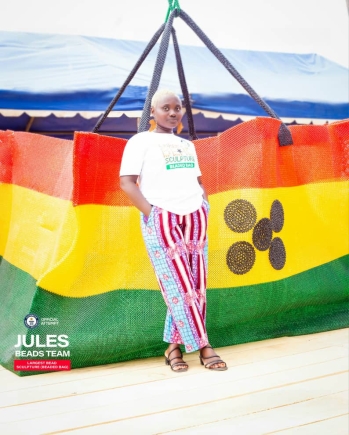
-
What form would the sculpture take?
-
How would the beads be arranged?
-
What colours would be used?
-
How would stability be ensured?
-
How long would it take to complete?
The final design combined aesthetic impact with symbolic depth, drawing inspiration from African identity, unity, and endurance. While the scale was unprecedented, the intention remained rooted in storytelling.
The Technical Challenge of Scale
Creating a bead sculpture of record-breaking size introduced technical challenges far beyond ordinary beadwork.
1. Material Sourcing
Thousands—if not millions—of beads were required. The team sourced beads of consistent quality, size, and colour to ensure uniformity. This process alone took weeks.
2. Structural Engineering
Unlike small bead accessories, a massive sculpture requires a support framework. Engineers and designers collaborated to build a structure capable of bearing the weight of countless beads without collapsing.
3. Labour and Coordination
The sculpture could not be completed by one person. Every team member had specific roles, from threading and placement to quality control and documentation.
4. Time and Endurance
The project demanded long hours of repetitive, physically taxing work. Bead by bead, row by row, the sculpture slowly came to life. Fatigue was inevitable, but morale remained high.
Juliana often worked alongside her team, leading not just with instruction but with participation—threading beads, correcting alignments, and offering encouragement.
Documentation and Verification
Guinness World Records requires rigorous documentation. Every stage of the process had to be recorded, measured, and verified by independent witnesses. The team meticulously followed guidelines to ensure the attempt would qualify.
This included:
-
Precise measurements of the final sculpture
-
Time logs of the creation process
-
Video and photographic evidence
-
Witness statements
The pressure was intense. A minor oversight could invalidate months of work.
But when the sculpture was finally completed and measurements confirmed, the result was undeniable: a new world record.
The Moment of Recognition
When Guinness World Records officially recognised Juliana Gharbin and the Jules Beads team as the makers of the largest bead sculpture in the world, it marked a defining moment—not only for the team but for Ghanaian art as a whole.
The announcement was met with celebration, pride, and emotional relief. For many team members, it was the culmination of years of dedication to a craft often underestimated.
“It felt surreal,” Juliana recalled. “We knew how much work went into it, but seeing it acknowledged globally was overwhelming.”
Cultural Impact and National Pride
The achievement resonated deeply in Ghana. Beadmaking, long associated with tradition and ceremony, was suddenly in international headlines—not as folklore, but as innovation.
Cultural analysts noted that the record:
-
Elevated indigenous art forms
-
Challenged stereotypes about African creativity
-
Demonstrated the global relevance of local craftsmanship
For young creatives, especially women and artisans working in traditional crafts, the success of Jules Beads became a powerful symbol of possibility.
Empowering Women Through Craft
Juliana Gharbin is also widely celebrated for her role in women’s empowerment. Many members of the Jules Beads team are women who gained skills, income, and confidence through the collective.
By leading a successful, globally recognised project, Juliana has shown that women-led creative enterprises can compete—and excel—on the world stage.
She frequently advocates for:
-
Skill development in traditional crafts
-
Recognition of artisans as professionals
-
Investment in creative industries
Beyond the Record: What’s Next?
For Juliana and Jules Beads, the Guinness World Records title is not an endpoint. It is a launchpad.
The team has since expressed interest in:
-
Expanding bead sculpture into public art installations
-
Collaborating with museums and galleries
-
Training the next generation of bead artists
-
Exploring international exhibitions
Juliana has also hinted at future record attempts, though she insists that impact—not titles—remains the priority.
“Our goal is to tell stories with beads,” she says. “If the world listens, that’s a blessing.”
Redefining Bead Art
What sets Juliana Gharbin and the Jules Beads team apart is not just their technical achievement, but their redefinition of bead art. They have shown that beads can be monumental, conceptual, and globally significant.
In doing so, they have bridged:
-
Tradition and modernity
-
Craft and fine art
-
Local heritage and global recognition

