When a Migratory Kite Fell from the Sky: What One Bird’s Journey Reveals About Conservation in Ghana
Late last month, a lone migratory bird—commonly known as a kite—completed a remarkable journey across continents, flying more than 3,000 miles before arriving in Ghana. For the purpose of this story, let us call the bird Anomapa, a local name that reflects both its mystery and its unintended role as a messenger.
Anomapa’s journey, however, did not end in triumph. Instead, it ended in tragedy—one that has sparked national conversation about wildlife conservation, public education, and the fragile relationship between communities and nature.
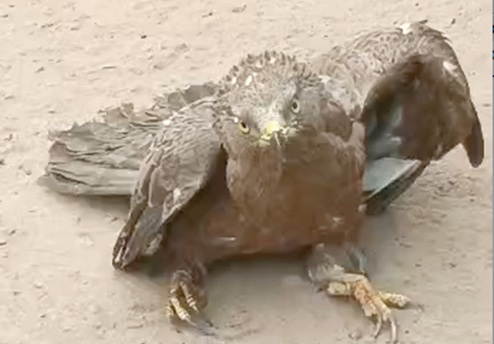
The bird was discovered wounded at Assin Breku Kwame Ankra, a farming community in the Assin North District of Ghana’s Central Region. A 32-year-old farmer, Mr Ebenezer Lativi, found the bird bleeding on his farm and acted quickly to rescue it. Despite his efforts and subsequent intervention by authorities, Anomapa died three days later at the Kumasi Zoo, where it had been receiving veterinary attention.
Many conservationists believe this unfortunate outcome could have been avoided if there were greater public awareness about migratory birds, their ecological importance, and the scientific research methods used to track them. Instead, fear, misinformation, and deeply rooted cultural beliefs combined to delay timely intervention—ultimately costing the bird its life.
The Discovery on the Farm
According to Mr Lativi, the incident began like any ordinary day on his farm. While tending to his crops, he noticed blood stains on leaves scattered across the ground. Alarmed by the sight, he followed the trail until he came upon a bird lying weak and injured among the vegetation.
“It was bleeding heavily and struggling to move,” he recounted. “At first, I thought it had been attacked by another animal.”
As he drew closer, Mr Lativi noticed something unusual: a metal ring fastened securely around one of the bird’s legs. Curious and concerned, he examined it more closely and discovered inscriptions etched onto the ring. Among them were the words “Museum Science, 1000 BRUSSEL,” a website address—www.ring.ac—and a unique identification code: H220252.
What he had stumbled upon was no ordinary bird.
Unaware of the full implications but sensing the situation was serious, Mr Lativi took the bird home and alerted officials of the local assembly. Word spread quickly through the community, and with it came fear, speculation, and rumour.
Fear, Myth, and Misinterpretation
In the absence of clear information, some residents began to insist that the bird was not natural. To them, Anomapa was mysterious—possibly spiritual, perhaps even malevolent. Despite the visible scientific identification ring on its leg, rumours circulated that the bird had been sent to cause harm or misfortune.
Before reason prevailed, the bird had already been shot, sustaining injuries that would later prove fatal.
This reaction, conservationists say, highlights a persistent challenge in wildlife protection: the gap between scientific knowledge and community understanding. In many rural areas, unfamiliar wildlife—especially animals that appear suddenly or behave unusually—is often interpreted through spiritual or superstitious lenses.
Eventually, calmer voices prevailed. The identification ring became undeniable evidence that the bird was linked to scientific research, not spiritual forces. After consultations and explanations, community leaders agreed to hand the bird over to agricultural officials so it could receive professional care.
By then, however, precious time had been lost.
From Assin to Kumasi
Following directives from the District Chief Executive, the injured kite was transported to veterinary officers and later transferred to the Kumasi Zoo for specialised care. Despite the efforts of wildlife professionals, Anomapa succumbed to its injuries three days later.
News of the bird’s death quickly spread beyond Assin North, attracting national attention and raising important questions: Why was such a bird in Ghana? What was the significance of the ring? And how many other migratory birds pass through Ghana unnoticed—or worse, harmed?
What Are Kites?
Kites are a subgroup of birds of prey closely related to hawks and eagles. They are typically identified by their long, tapering wings, relatively small claws, and rounded heads. Their flight is graceful and buoyant, often involving effortless gliding as they scan the ground for prey.
Although they resemble falcons and were once classified as such, modern scientific research has placed them firmly within the hawk and eagle family. Many species of kites are migratory, travelling thousands of miles between breeding and feeding grounds across continents.
Such journeys are physically demanding. By the time these birds reach their destinations, they are often exhausted, malnourished, and vulnerable—making them especially susceptible to injury, human interference, or environmental hazards.
The Meaning of the Metal Ring
The metal band attached to Anomapa’s leg was not decorative, nor mystical. It was a scientific identification tag issued by the Royal Belgian Institute of Natural Sciences in Brussels.
According to wildlife conservationist Paul Asimeng, Site Manager of the Sakumono Ramsar Site, bird ringing—or banding—is a globally recognised scientific method used to study birds. The process involves attaching a lightweight metal ring with a unique identification number to a bird’s leg. The method causes minimal stress and does not hinder the bird’s ability to fly, hunt, or migrate.
“This is how scientists track migration routes, lifespan, breeding patterns, and population trends,” Mr Asimeng explained. “It helps us understand where birds come from, where they go, and the threats they face along the way.”
The inscription “BRUSSELS” on the ring confirmed that Anomapa was part of an international research programme. Following the bird’s discovery and subsequent death, the Royal Belgian Institute of Natural Sciences was formally notified.
“There is absolutely nothing spiritual about such birds,” Mr Asimeng emphasised. “They are ambassadors of science and indicators of environmental health.”
Ghana: A Crucial Stop on Global Migration Routes
Ghana occupies a strategic position along major migratory bird routes between Europe, Asia, and Africa. According to the World Bird Database (last updated in 2025), Ghana is home to 771 bird species, including 38 globally threatened species and one newly introduced species.
Many migratory birds pass through Ghana seasonally, stopping to rest and feed before continuing their journeys. Areas such as wetlands, farmlands, forests, and coastal zones serve as critical habitats.
The Assin North area, Mr Asimeng noted, may lie along one such migratory corridor.
“These birds travel enormous distances,” he said. “When they arrive, they are often weak and exhausted. Any additional stress—injury, disturbance, or delayed care—can be fatal.”
The Bigger Ecological Picture
Birds play a vital role in maintaining healthy ecosystems. They act as pollinators, seed dispersers, and natural pest controllers. By feeding on insects and rodents, they protect crops and support agricultural productivity. Scavenger birds, such as vultures, help prevent the spread of disease by consuming carcasses.
Yet many of these species are under threat. In Ghana, vultures—once a common sight—are now nearly extinct due to poisoning, habitat loss, and human persecution.
“The ecosystem is like a chain,” Mr Asimeng explained. “When you remove one link, the entire system is affected.”
From rodents to snakes to birds, each species plays a role in maintaining balance. Disrupting that balance has consequences that ultimately affect human survival and wellbeing.
Education as the Missing Link
One of the clearest lessons from Anomapa’s story is the urgent need for public education. Knowledge about migratory birds, conservation laws, and wildlife reporting mechanisms remains limited, particularly in rural communities.
“If people had known what that ring meant, the bird might still be alive,” Mr Asimeng said.
He urged residents who encounter unusual or injured wildlife to report immediately to the nearest veterinary office, the Forestry Commission, or wildlife authorities. Early intervention can make the difference between life and death.
Authorities have indicated that efforts to intensify education on wildlife conservation and ecosystem protection will be stepped up to prevent similar incidents in the future.
Every Bird Counts
The timing of the incident is particularly poignant as the world prepares for the 2026 World Migratory Bird Day, which will be celebrated under the theme: “Every Bird Counts – Your Observations Matter!”
The campaign emphasises the role of communities and citizen science in monitoring and protecting migratory birds. Individual sightings, reports, and local knowledge contribute to global conservation databases and inform international policy decisions.
Anomapa’s journey—though tragically cut short—has become part of that global story.
A Final Reflection
The death of a single bird may seem insignificant in a world facing countless challenges. But nature does not operate in isolation. Each loss ripples outward, affecting ecosystems, food chains, and ultimately human life.
Anomapa crossed oceans and continents, carrying with it data, stories, and ecological value. Its fate serves as a sobering reminder that coexistence with nature requires understanding, patience, and respect.
If Ghana is to protect its rich biodiversity and its role in global conservation efforts, the guiding principle must be simple yet profound: live and let live.
Only then can future travellers of the sky complete their journeys safely.