


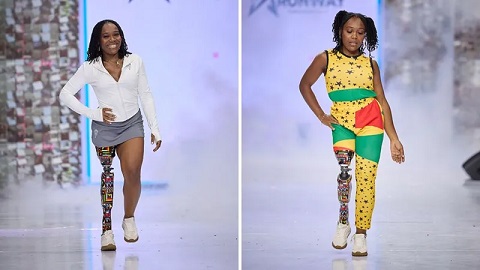
It was impossible to ignore 33-year-old model and writer Abena Christine Jon’el as she stepped onto the runway at one of Ghana’s most prominent fashion shows. Amid the flowing fabrics, dramatic lighting, and rhythmic music, her presence commanded attention—not because she sought it, but because her story demanded to be seen.
With her prosthetic leg wrapped in a vibrant African print, Abena walked with confidence and grace, turning what many still perceive as a limitation into a bold symbol of identity, beauty, and resilience. For many in the audience, it was a moment of surprise. For others, it was deeply moving. For Abena herself, it was a continuation of a lifelong mission: to redefine visibility for people with disabilities and challenge narrow ideas of beauty and worth.
“I didn’t come here just to model clothes,” she would later explain. “I came to show that disabled bodies belong everywhere—including on the runway.”
A life altered at two years old
At just two years old, Abena’s life took a turn that would shape her journey in ways most adults would struggle to comprehend. A severe medical condition led to the amputation of her leg, thrusting her and her family into a world of hospitals, rehabilitation, and emotional adjustment long before she was old enough to understand what had happened.
Growing up, she learned early that disability was not only a physical reality but also a social one. Stares, questions, silence, and sometimes cruelty became part of her everyday experience. While other children learned how to fit in, Abena was learning how to exist in spaces that were not designed with her in mind.
Yet even 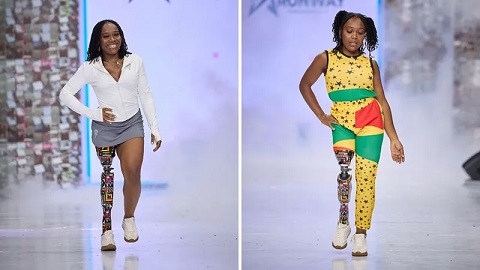 as a child, she showed signs of a fierce inner strength. Supported by her family, she learned to walk with a prosthetic, to adapt, and—most importantly—to refuse the idea that her future had been diminished.
Growing up between worlds
As a Ghanaian-American, Abena grew up navigating multiple identities—cultural, national, and personal. In the United States, disability advocacy was more visible, though still imperfect. In Ghana, conversations around disability were often shaped by stigma, misunderstanding, or silence.
She noticed early on how differently people with disabilities were treated across societies, but also how similar the underlying challenges were: lack of representation, limited access, and deeply ingrained stereotypes.
“In both places, disabled people are often spoken about but rarely spoken with,” she has said. “That’s something I wanted to change.”
These experiences planted the seeds for her later work as a writer, speaker, and advocate, using storytelling to bridge cultural gaps and confront uncomfortable truths.
Finding her voice through writing
Before fashion found her, writing did. Words became Abena’s way of making sense of the world and asserting control over her narrative. Through essays, articles, and personal reflections, she explored themes of disability, race, womanhood, beauty, and belonging.
Her writing challenged the idea that disabled people exist solely to inspire or to be pitied. Instead, she presented disability as a complex, lived experience—one that includes joy, frustration, ambition, love, and contradiction.
Over time, her work gained attention in advocacy circles, particularly in the US, where she participated in panels, workshops, and community discussions centered on disability justice and representation.
But Ghana always remained close to her heart.
Returning to Ghana with a purpose
Abena’s work in Ghana has focused on visibility and dialogue. While disability is far from invisible in the country, people with disabilities are often excluded from mainstream conversations around fashion, media, employment, and leadership.
She observed that disabled bodies were rarely portrayed as stylish, desirable, or powerful. When they were seen at all, they were often framed through charity or hardship rather than agency.
That’s why stepping onto a Ghanaian runway carried such weight.
“This wasn’t about me being brave,” she said. “It was about challenging a system that decides who gets to be seen as beautiful.”
Fashion as activism
Fashion has long been a powerful cultural force in Ghana, blending tradition, innovation, and self-expression. By participating in a major fashion show, Abena deliberately entered a space that shapes public imagination.
Her prosthetic leg, wrapped in African print, was not hidden or neutralized. It was highlighted—celebrated as part of the look, not something to be disguised. The fabric connected her disability to heritage, culture, and pride.
For many audience members, it was the first time they had seen a disabled model presented not as an exception, but as a statement.
Designers, photographers, and fellow models later described the moment as transformative, prompting conversations about inclusion that extended beyond the event itself.
Challenging beauty standards
Abena’s presence also confronted deeply rooted beauty standards—not only around disability, but around race, gender, and body norms.
Mainstream fashion has historically promoted a narrow image of perfection: able-bodied, thin, young, and often Eurocentric. Disabled bodies, when included at all, are frequently tokenized.
By walking the runway unapologetically, Abena disrupted those assumptions.
“Beauty isn’t about symmetry or perfection,” she often says. “It’s about truth.”
Her message resonated especially with young people, many of whom reached out afterward to share how seeing her walk the runway changed the way they viewed themselves or their loved ones with disabilities.
The emotional weight of representation
Representation carries power—but it also carries responsibility. Abena has spoken openly about the emotional weight of being one of the few visible disabled figures in spaces like fashion and media.
“There’s pressure to get it right, to represent everyone,” she admits. “But no single person can do that.”
Instead, she emphasizes the importance of opening doors, not standing alone in them. Her hope is that her visibility will make it easier for other disabled creatives—especially Africans—to enter spaces that have long excluded them.
Reactions and ripple effects
The response to Abena’s runway appearance extended far beyond the venue. Images and videos circulated online, sparking conversations about disability inclusion in Ghana and across the diaspora.
Some praised her courage and elegance. Others admitted that the moment forced them to confront their own assumptions and biases. Importantly, people with disabilities saw themselves reflected in a space where they had rarely been acknowledged.
Fashion insiders began asking questions about accessibility, casting practices, and inclusive design—small but meaningful steps toward systemic change.
Looking forward
For Abena Christine Jon’el, the runway moment was not a conclusion, but a continuation.
She remains committed to her work as a writer and advocate, using storytelling to push for more inclusive narratives. She hopes to see a future where disabled people in Ghana and beyond are visible not as exceptions, but as participants in everyday life—artists, professionals, lovers, leaders, and creators.
Her vision is simple yet radical: a world where disability is neither hidden nor sensationalized, but fully human.
More than a moment
As the lights dimmed and the show moved on, Abena’s walk lingered in the minds of many who witnessed it. Not because it was shocking, but because it was honest.
In a society that often equates worth with physical perfection, her presence was a reminder that strength, beauty, and impact are not limited by the body.
At two years old, her life was altered by circumstances beyond her control. At 33, Abena Christine Jon’el is actively shaping how that life—and others like it—are seen.
And on that runway in Ghana, with African print wrapped proudly around her prosthetic leg, she wasn’t just modeling fashion.
She was modeling possibility.

