


A recent initial review of the 60 Aayalolo buses moved to Kumasi since 2018 shows that there is no sign of any income being generated from them.
The early studies on how the Aayalolo buses have been run over the last eight years showed that there were issues with how responsibilities were handled and how the operations were planned, which resulted in 44 buses being taken out of service.
After that, the Managing Director of the Greater Accra Passenger Transport Executive, Awudu Dawuda, has arranged for an independent audit. The purpose of this audit is to find out why the 60 buses were sent to Kumasi, how they were used during their operation, and how much money was collected from their use.
The audit was planned to finish in one month after finding out that since 2018, when the buses moved to Kumasi, no money had been put into the GAPTE account.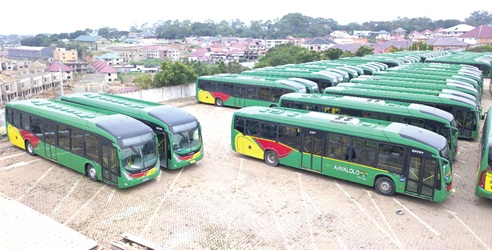
Audit
In an exclusive interview with the Daily Graphic last Friday, Mr. Awudu stated that the audit was part of GAPTE’s major transformation plan aimed at recovering all assets and revamping the bus rapid transport (BRT) system to improve urban mobility. Graphic Online Access.
He said that when he took office six months ago, it was discovered that 60 out of the 245 Aayalolo buses that were bought to run on specific roads in the Greater Accra Region had been sent to Kumasi. Also, 10 more buses were taken to Takoradi in the Western Region.
Mr Awudu stated that a first look at how the buses in Kumasi are being managed showed that since 2018, GAPTE, the organization responsible for overseeing the Aayalolo buses, has not received any income.
The issue is that since the buses were moved to Kumasi in 2018, not a single penny from the passengers has been received as revenue by GAPTE; there was no proper plan for these buses – they were sent there without following the law, and since 2018, no revenue has come to GAPTE.
Get the digital newspaper straight to your laptop, phone, and tablet.
He said that the first results showed the buses were given to the Kumasi Metropolitan Assembly (KMA) to manage in 2018, and GAPTE engineers mainly repaired them in Kumasi, with the cost of those repairs covered by the Council.
He said the audit team will find out the situations in which the buses arrived in Kumasi, who got them, how the money from them was handled, and the conditions that led to six of the buses being set on fire.
He said that with the help of the Minister of Local Government, Chieftaincy and Religious Affairs, Mr Ahmed Ibrahim, GAPTE was able to take control of the remaining 54 buses in Kumasi, and the process had started to take over the 10 buses in the Western Region.
The GAPTE boss said that when they took over the 54 buses, they found out only 16 were working and the rest were not operational.
“Since we began running those 16 buses two weeks ago, we’ve been making good money; so, we are working on fixing the other buses and getting them back into service,” he said.
Collapsed system
Mr Awudu said the way the buses in Kumasi are being managed shows that the whole system has broken down, and that’s why the current GAPTE management came to address it.
For example, he mentioned that out of the 245 BRT buses purchased by the government in 2016, only 80 were still working, while the majority were out of service because of bad maintenance practices.
He also mentioned that some of GAPTE’s facilities and terminals were facing serious encroachment, particularly the ones in Kasoa, Adenta, Kinbu, and Achimota.
He also mentioned that from 2018 up to now, GAPTE has been struggling with a large amount of debt from buying fuel.
Progress
Mr Awudu mentioned that as part of the government’s transformation plan, GAPTE has begun taking back properties that were taken over illegally and fixing old buses to make sure they work as well as possible.
“When I first started my job, there were 80 buses that were working properly, but we have fixed and added 60 more buses, bringing the total number of working buses to 140. Now, these buses run until around 11 p.m., which is later than the usual 5 p.m. closing time,” he said.
He also mentioned that all the bus terminals which had been taken over were brought back and are now fully controlled by GAPTE.
He also mentioned that GAPTE set up a visiting area for passengers at the Kinbu terminal to help with their work.
We have also repaired and updated the depot or workshop at Achimota where all our buses are maintained.
He also said that all our broken buses are fixed at that place, and they do regular maintenance there too.
Urban traffic management
Mr Awudu said that as part of efforts to manage traffic better and reduce congestion in the city, GAPTE is introducing measures to start using dedicated lanes again for the Aayalolo buses.
He said they asked the Spanish government for financial help to get the special lanes back in use, and they’ve been approved for a €1 million grant that will go toward a study to see how the special lanes can be operated.
He said that while they were waiting for the grant, GAPTE was working with the Mayor of Accra and the Ministry of Local Government, Chieftaincy and Religious Affairs to begin using the dedicated BRT lanes. Demographics.
Very soon, the Aayalolo buses will begin running on their special lanes.

