


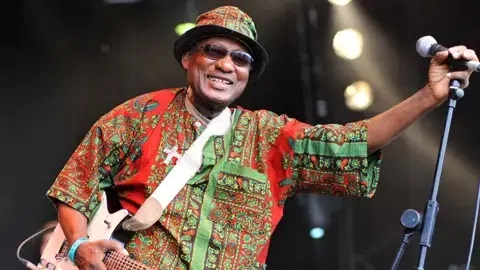
Tributes have been pouring in from across Ghana and around the world following the death of Ghanaian highlife legend Ebo Taylor, whose six-decade career helped shape modern popular music in West Africa and beyond.
A guitarist, composer, arranger and bandleader, Taylor died on Saturday, just a day after the launch of a music festival in Accra bearing his name and barely a month after celebrating his 90th birthday. He is widely regarded as one of the founding fathers of contemporary highlife.
Highlife — a genre that blends traditional African rhythms with jazz, funk and Caribbean influences — was recently inscribed on UNESCO’s Intangible Cultural Heritage list, underscoring the global significance of the musical tradition Taylor helped define.
“The world has lost a giant. A colossus of African music,” a statement shared on his official page read. “Your light will never fade.”
Tributes have come from across the global music community. The Los Angeles–based collective Jazz Is Dead described him as a pioneer of highlife and Afrobeat, while Ghanaian dancehall star Stonebwoy and American producer Adrian Younge, who has worked with artists such as Jay-Z and Kendrick Lamar, also honoured his legacy. Nigerian writer and poet Dami Ajayi hailed him as a “highlife maestro” and a “fantastic guitarist.”
Often affectionately referred to as “Uncle Ebo,” Taylor’s influence extended far beyond Ghana. Elements of his music can be heard in the soul, jazz, hip-hop and Afrobeat sounds that dominate African and global charts today.
Born Deroy Taylor in Cape Coast in 1936, he began performing in the 1950s, as highlife was emerging as Ghana’s dominant post-independence sound. Renowned for his intricate guitar work and rich horn arrangements, he played with leading bands including the Stargazers and the Broadway Dance Band.
In the early 1960s, Taylor travelled to London to study music, where he collaborated with fellow African musicians, including Nigerian Afrobeat pioneer Fela Kuti. Their exchange of ideas would later prove formative to the development of Afrobeat — a politically charged fusion of highlife, funk, jazz and soul.
After returning to Ghana, Taylor became one of the country’s most sought-after arrangers and producers. He worked with highlife greats such as Pat Thomas and C.K. Mann, while also leading his own bands.
His classic compositions — including Love & Death, Heaven, Odofo Nyi Akyiri Biara and Appia Kwa Bridge — enjoyed renewed international attention decades later as DJs, collectors and record labels reissued his music. His grooves were sampled by hip-hop and R&B artists, introducing new generations of listeners to Ghanaian highlife.
Taylor continued touring well into his 70s and 80s, performing across Europe and the United States during a late-career renaissance that cemented his status as a cult icon among younger musicians.
To many, Ebo Taylor remained a symbol of highlife’s golden era and of a generation that carried Ghanaian music onto the world stage. His legacy endures not only in his recordings, but in the global musical currents he helped set in motion.

