The Ministry of Health has announced the establishment of a special investigative committee to probe allegations of so-called “medical kalabule” at two of Ghana’s leading health facilities—the Korle-Bu Teaching Hospital and the Greater Accra Regional Hospital (Ridge). The move follows mounting public concern and complaints about alleged extortion, unauthorized fees, and unethical practices within parts of the public healthcare system.
In a statement issued on Tuesday, the Ministry said the probe is aimed at uncovering the truth behind allegations that some health workers are demanding unofficial payments from patients, diverting essential medical supplies, and manipulating access to services for personal gain. The Ministry described the allegations as “serious and damaging” to public trust in the healthcare system and pledged to take firm action if wrongdoing is established.
Background to the allegations
The term “medical kalabule”—a colloquial expression referring to profiteering and exploitation—has increasingly been used by patients and civil society groups to describe alleged practices in some public hospitals. These include claims that patients are being asked to pay cash directly to staff for services that should be covered by the National Health Insurance Scheme (NHIS), as well as allegations of preferential treatment for those who offer inducements.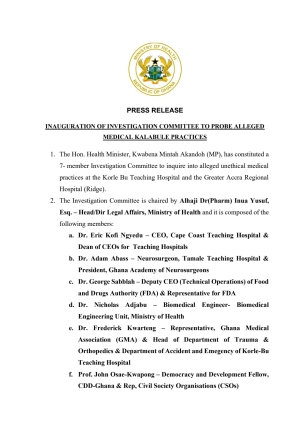
At Korle-Bu and Ridge, both major referral hospitals serving thousands of patients daily, reports have circulated of individuals allegedly paying unofficial fees to fast-track appointments, access beds, or secure medical supplies such as drugs, gloves, and consumables that are officially meant to be provided by the hospitals.
Although hospital management has previously denied institutional involvement in such practices, the persistence of complaints has prompted the Ministry of Health to escalate the matter to a formal investigation.
Scope and composition of the probe
According to the Ministry, the investigative committee will include representatives from the Health Ministry, the Ghana Health Service, the Teaching Hospitals Directorate, and other relevant oversight bodies. The committee has been tasked with examining both administrative and clinical processes at the two hospitals.
Its mandate includes:
-
Investigating allegations of unauthorized charges and extortion
-
Assessing compliance with NHIS billing and service delivery rules
-
Examining the handling and distribution of medical supplies and consumables
-
Reviewing patient complaints and whistleblower reports
-
Identifying systemic weaknesses that may enable corrupt practices
The committee is expected to engage hospital management, frontline health workers, patients, and other stakeholders as part of its work. Officials say confidentiality and protection for whistleblowers will be prioritized to encourage candid testimony.
Ministry’s warning and commitment
In announcing the probe, the Ministry of Health issued a stern warning to health workers who may be engaged in unethical practices, stressing that the investigation will not be a mere formality.
“The Ministry will not hesitate to recommend disciplinary or legal action where wrongdoing is proven,” the statement said. “Public healthcare must not become an avenue for exploitation. Any conduct that undermines patient welfare and public confidence will be dealt with decisively.”
The Ministry emphasized that while many healthcare professionals work under difficult conditions and serve with integrity, allegations of misconduct by a few can tarnish the image of the entire sector if left unaddressed.
Impact on patients and public trust
For many Ghanaians, public hospitals like Korle-Bu and Ridge represent the last line of affordable healthcare. Allegations of medical kalabule have therefore struck a sensitive nerve, particularly among low-income patients who rely heavily on the NHIS.
Patient advocacy groups argue that unofficial payments not only impose financial hardship but also create inequities in access to care. According to these groups, patients who cannot afford to pay extra may experience longer waiting times, reduced attention, or delayed treatment.
Health policy analysts warn that if such practices are allowed to persist, they risk eroding confidence in the public healthcare system and pushing more people toward unregulated private alternatives or self-medication.
Response from hospital authorities
Management of both Korle-Bu Teaching Hospital and Ridge Hospital have welcomed the Ministry’s decision to investigate, stating that they are ready to cooperate fully with the committee.
In separate statements, the hospitals reiterated their commitment to ethical service delivery and encouraged staff and patients to support the probe. They also reminded the public that official hospital charges are published and that patients should report any demands for unofficial payments through established complaint channels.
Hospital authorities noted that high patient volumes, resource constraints, and staff shortages can create operational pressures but stressed that these challenges do not justify unethical behavior.
Broader systemic challenges
The probe has reignited debate about broader structural issues in Ghana’s healthcare system. Experts note that delayed NHIS reimbursements, inadequate funding, and logistical challenges can create incentives for informal payments if not properly managed.
However, analysts caution against using systemic challenges as an excuse for corruption. They argue that addressing both accountability and resourcing is essential to restoring integrity in the health sector.
Some have called for stronger internal audit systems, improved patient feedback mechanisms, and the use of digital tools to reduce human discretion in billing and service delivery.
Role of whistleblowers and civil society
Civil society organizations have praised the Ministry’s action and urged it to ensure transparency throughout the investigation. They have also encouraged patients and staff with information to come forward.
Whistleblower advocates stress that fear of victimization often prevents individuals from reporting misconduct. They are calling on the Ministry to guarantee protection for those who provide information and to communicate clearly about how complaints will be handled.
Possible outcomes and next steps
The investigative committee is expected to submit its findings within a specified timeframe, after which the Ministry will determine appropriate actions. These may include administrative sanctions, referrals to law enforcement agencies, policy reforms, or operational changes within the hospitals.
The Ministry has indicated that the probe may be extended to other facilities if evidence suggests that the alleged practices are widespread.
A test of accountability in healthcare
The investigation into alleged medical kalabule at Korle-Bu and Ridge represents a critical test of accountability within Ghana’s public healthcare system. For patients, it is a chance to see whether longstanding complaints will finally be addressed. For health workers, it is a reminder of the ethical standards expected in the profession.
As the probe gets underway, public attention will remain firmly fixed on its findings and the actions that follow. Many observers say the credibility of the healthcare system—and the trust of patients—will depend on whether the investigation leads to meaningful reform rather than temporary reassurance.
In the words of one health policy expert, “This is not just about two hospitals. It is about reaffirming that public healthcare exists to serve patients, not to exploit them.”