


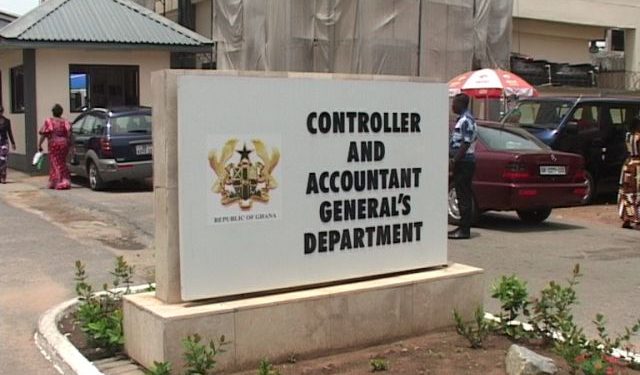
The Controller and Accountant-General’s Department (CAGD) has announced the immediate suspension of salaries for 2,563 government employees after they failed to comply with a mandatory nationwide headcount exercise, a move that signals a tougher stance against payroll irregularities in the public sector.
The decision, which took effect from the January 2026 payroll, was implemented following a direct recommendation from the Auditor-General and forms part of broader efforts to sanitize the government wage bill. Officials say the action is aimed at eliminating ghost names, unearned salaries, and other long-standing inefficiencies that continue to drain public finances.
According to the CAGD, the affected workers were given ample notice and multiple opportunities to present themselves for the verification exercise but failed to do so within the stipulated timeframe. As a result, their names were automatically flagged and removed from the payroll pending further verification.
A critical nationwide headcount
The nationwide headcount formed part of a wider public payroll validation exercise, designed to ensure that only legitimately employed workers are paid from the Consolidated Fund. The exercise required all government employees to physically present themselves at designated centers to verify their identity, employment status, and placement.
The verification process typically involves biometric confirmation, validation of appointment letters, confirmation of duty post, and cross-checking against existing payroll records. Officials familiar with the exercise say it was intended to close loopholes that allow salaries to be paid to individuals who may have exited public service, changed roles without proper documentation, or in some cases, never existed.
The CAGD emphasized that the headcount was not optional and that participation was a statutory requirement tied directly to salary payments.
Auditor-General’s role and recommendation
The move follows persistent concerns raised by the Auditor-General over weaknesses in payroll controls. In several audit reports, the Auditor-General has highlighted instances where public funds were lost through the payment of unearned salaries and allowances, sometimes running into tens of millions of cedis.
In this instance, the Auditor-General formally recommended the suspension of salaries for workers who failed to validate their employment status during the headcount. The recommendation was based on audit findings suggesting that failure to appear for verification could indicate payroll fraud, administrative lapses, or non-compliance with public service regulations.
By acting on the recommendation, the CAGD signaled its intention to strengthen collaboration with audit and anti-corruption institutions to enforce accountability within the public financial management system.
A firm warning to public sector workers
In a statement accompanying the announcement, the CAGD described the suspension as a corrective, not punitive, measure, stressing that affected workers still have an opportunity to regularize their status.
“The suspension of salaries is meant to protect the public purse and ensure value for money,” the statement noted. “Any affected employee who can prove their legitimacy and comply with the verification requirements will be restored to the payroll, subject to due process.”
However, officials were clear that reinstatement would not be automatic. Employees seeking restoration must undergo additional scrutiny, and any payments made retrospectively will depend on the outcome of the verification.
The CAGD also warned that future exercises may attract even stricter sanctions, including disciplinary action against supervisors or departmental heads who fail to ensure compliance by their staff.
Part of a broader payroll cleanup
The salary suspension is part of a broader government initiative to clean up the public payroll, which has long been identified as a major source of fiscal leakage. Ghana’s public sector wage bill consumes a significant portion of annual government expenditure, leaving limited room for capital investment and social programs.
Over the years, successive audits have uncovered ghost workers, duplicate entries, and employees drawing salaries without proper authorization. In some cases, individuals continued to receive pay months or even years after retirement, resignation, or death.
The latest action suggests a shift from warnings and recommendations to direct enforcement, reflecting growing pressure on state institutions to demonstrate fiscal discipline amid economic constraints.
Links to ongoing investigations
The payroll crackdown also coincides with ongoing investigations into GH¢42 million in unearned salaries and allowances, which the CAGD is reportedly probing in collaboration with the Office of the Special Prosecutor (OSP).
That probe focuses on payments made without proper authorization, including allowances and salary arrears that may not have been backed by valid employment records. Officials say lessons from those investigations have informed the decision to act decisively against non-compliant workers in the latest headcount.
By aligning payroll management with anti-corruption enforcement, authorities hope to send a strong signal that payroll fraud will no longer be treated as an administrative inconvenience but as a serious breach of public trust.
Impact on affected workers
For the 2,563 affected employees, the sudden suspension of salaries has immediate financial implications. Many rely solely on their monthly pay to meet basic needs, and the halt has sparked anxiety among those who claim they were unable to attend the headcount due to illness, travel, or administrative challenges.
Public sector unions are expected to seek further clarification from the CAGD, particularly regarding timelines for verification and reinstatement. Some labor representatives have called for flexibility in cases where employees can demonstrate genuine reasons for their absence.
However, others within organized labor have acknowledged the need for reform, noting that payroll irregularities undermine the credibility of the public service and divert resources away from deserving workers.
Accountability beyond employees
Beyond individual workers, the situation has renewed focus on the responsibility of supervisors and human resource units within ministries, departments, and agencies. Analysts argue that payroll integrity cannot be achieved solely by targeting employees; it also requires holding managers accountable for maintaining accurate staff records.
The Auditor-General has repeatedly called for sanctions against heads of institutions who allow irregular payments to persist. The current exercise may therefore pave the way for further administrative or legal action against officials found to have enabled or ignored payroll anomalies.
Ensuring fairness and transparency
The CAGD has assured the public that the process will be handled transparently and fairly. Dedicated desks have reportedly been set up to handle complaints, appeals, and verification requests from affected workers.
At the same time, the department has urged all public sector employees to treat future headcounts and verification exercises with seriousness, stressing that non-compliance will have direct consequences.
A signal of tougher times ahead
The suspension of salaries for over two thousand government workers represents one of the most decisive payroll enforcement actions in recent years. It reflects mounting pressure on state institutions to protect public funds, improve efficiency, and restore confidence in public financial management.
As Ghana continues efforts to stabilize its economy and manage limited resources, measures such as this underscore a clear message: public funds will be guarded more aggressively, and accountability within the public service is no longer negotiable.
Whether the action ultimately leads to a cleaner payroll system will depend on sustained enforcement, transparent processes, and the willingness of all stakeholders—employees, managers, and oversight bodies—to uphold the rules governing public service employment.

