


Paris, France — Artificial intelligence pioneer Yann LeCun has challenged the widespread belief that today’s leading AI models, including ChatGPT, Claude and Gemini, are on the path to achieving human-level intelligence, arguing instead that they lack a fundamental understanding of the physical world.
Speaking on the sidelines of VivaTech, France’s premier technology conference, LeCun said existing large language models (LLMs) are powerful tools for tasks such as coding, writing and solving mathematical problems, but remain incapable of reasoning about real-world environments in the way even simple animals can.
“We don’t have robots that are nearly as good at understanding the physical world as a rat,” LeCun said, highlighting what he believes is one of the biggest limitations of current AI technology.
Yann LeCun, founder of AMI Labs, is developing a new AI system
LeCun, one of the world’s most influential AI researchers, previously served as Chief AI Scientist at Meta, the parent company of Facebook. After leaving the company in 2025, he founded Advanced Machine Intelligence Labs (AMI Labs), a Paris-based startup focused on developing what he believes will be the next generation of artificial intelligence.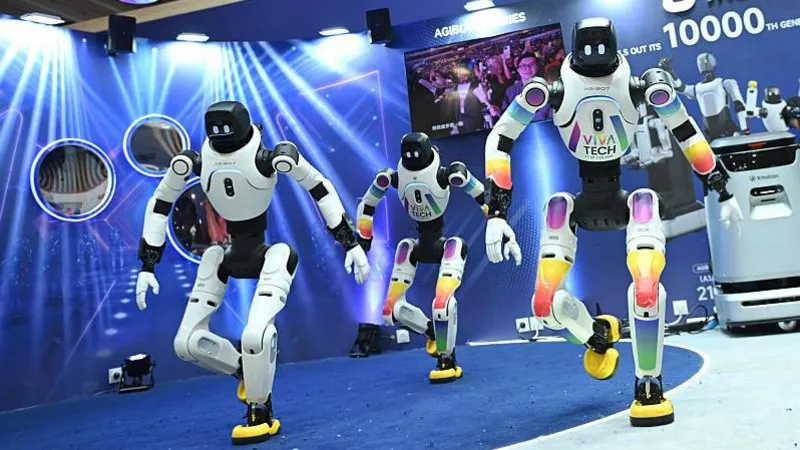
Beyond ChatGPT and Large Language Models
According to LeCun, today’s AI systems are built on large language models that excel at recognizing patterns in enormous amounts of text but do not genuinely understand how the world works.While models such as ChatGPT, Claude and Gemini have transformed industries by generating human-like text, writing computer code and answering complex questions, LeCun argues that these systems simply predict the most likely next word based on statistical patterns rather than reasoning through problems.
“They’re not a path towards human-level or human-like intelligence, or even animal-like intelligence, because they cannot deal with real-world data. They just are not built for that,” he said.He believes LLMs are effective only because they have absorbed vast quantities of information during training.
“They basically just accumulate knowledge. They can regurgitate something—you train them to regurgitate—but they’re not particularly smart. They don’t have an underlying understanding,” he explained.According to LeCun, this limitation means current AI systems struggle whenever they encounter situations that require common sense, physical reasoning or an understanding of cause and effect.
A Different Approach to Artificial Intelligence
Rather than improving existing language models by making them larger, LeCun’s company is pursuing an entirely different approach.AMI Labs is developing a new AI architecture known as Joint Embedding Predictive Architecture (JEPA). Unlike conventional language models, JEPA is designed to create abstract representations of the real world, allowing machines to understand how objects, environments and events relate to one another.
Instead of memorizing text, the system attempts to build an internal model of reality that can help it predict possible outcomes while ignoring unnecessary information.LeCun illustrated the difference with a simple example involving a pen balanced upright on its tip.
If someone lets go of the pen, even a young child understands that it will fall over. However, no one can accurately predict the exact direction in which it will land because countless tiny factors influence the outcome.
A conventional language model, LeCun argues, may attempt to predict one specific result based on patterns in its training data.By contrast, JEPA is designed to understand that predicting the precise direction is impossible and instead focus on what is certain—that the pen will topple because of gravity.For LeCun, this represents genuine reasoning rather than statistical prediction.
Backed by Billion-Dollar Investment
Investors appear convinced that LeCun’s vision has enormous potential.Earlier this year, AMI Labs announced that it had raised more than $1 billion in seed funding—one of the largest early-stage fundraising rounds ever completed by a European technology startup.
The investment attracted support from major technology players, including Nvidia, the American chipmaker powering much of today’s AI revolution, as well as the investment fund managing the private wealth of Amazon founder Jeff Bezos.The substantial funding will allow the company to continue developing its new AI architecture with the goal of applying it to robotics and industrial automation.
Why Robotics Needs Smarter AI LeCun believes one of the biggest beneficiaries of this new generation of artificial intelligence will be the robotics industry.
Although humanoid robots have become increasingly sophisticated in recent years, teaching them to perform ordinary household tasks remains one of the greatest challenges facing researchers.Simple activities such as loading a dishwasher, folding clothes, cleaning rooms or ironing require an understanding of physical environments that current AI systems struggle to achieve.
Billions of dollars have already been invested globally in developing robots capable of working alongside humans in homes, factories and hospitals.Yet despite rapid advances in hardware, the intelligence controlling many of these machines remains limited.
“LLMs are largely hopeless for robotics,” LeCun said.He also dismissed suggestions that simply increasing the size of today’s language models will eventually produce superhuman intelligence. The claims that somehow by just scaling up LLMs, we’re going to reach superhuman intelligence—that is simply not going to happen,” he argued.
Growing Support for World Models
LeCun’s views are increasingly shared by other researchers working at the cutting edge of artificial intelligence.Among them is Professor Ingmar Posner, Director of the Applied AI Lab at the University of Oxford and an Amazon Scholar. Posner believes future AI systems must go beyond predicting text and instead develop an understanding of cause and effect.
“My view is that the next decade will really be about systems that can explain,” he said.According to Posner, intelligent machines should be able to answer questions such as:
- What matters in this situation?
- What causes a particular outcome?
- What would happen if I chose a different action?
To answer those questions, Posner and his research team have spent four years developing what they describe as a mechanistic world model.Rather than storing isolated pieces of information, the system organizes knowledge in ways that allow it to recall, combine and adapt information when making decisions.
The Rise of World Models
The concept of World Models has existed in artificial intelligence research for decades but has gained significant momentum in recent years.A landmark 2018 research paper by David Ha and Jürgen Schmidhuber demonstrated how AI systems could learn by building internal simulations—or mental models—of the world. Instead of relying solely on massive datasets, these systems imagine possible future scenarios before making decisions.This approach has inspired several major AI projects.
Google DeepMind has developed Dreamer, a world model capable of learning through simulated experiences.A newer version of Dreamer successfully learned how to collect diamonds in the popular video game Minecraft by imagining future possibilities before acting.
Other organizations exploring similar approaches include Google’s Genie, autonomous driving company Wayve with its Gaia model, and World Labs, founded in 2023 by renowned AI scientist Fei-Fei Li.Together, these initiatives represent a growing movement within AI research aimed at creating machines that understand rather than merely predict.
Challenges Ahead
Despite growing enthusiasm, researchers acknowledge that building truly intelligent machines remains an enormous scientific challenge.Professor Posner cautioned that predicting when these systems will become practical is extremely difficult.He noted that only a few years before ChatGPT was introduced, many experts believed conversational AI was still decades away. “If you asked anyone in 2017 or 2018 how long it would be until you could have something like ChatGPT, they would have said decades,” Posner observed. The rapid progress achieved since then suggests future breakthroughs could arrive sooner than expected.
AMI Labs’ Roadmap
LeCun says AMI Labs plans to spend the remainder of this year refining its JEPA architecture before deploying the technology in industrial applications next year.Factories, warehouses and manufacturing facilities are expected to be among the first environments where the technology will be tested.
If successful, the company hopes to expand into broader applications involving autonomous robots capable of adapting to new situations with minimal retraining.Ultimately, LeCun envisions general-purpose intelligent systems that can perform a wide variety of real-world tasks while continuously learning from experience.”Eventually down the line we’ll have general, generic intelligence systems that can be applied to just about anything in the world with minimal training or fine-tuning,” he said.
Will AI Replace Humans?
As artificial intelligence continues to evolve, concerns about job losses and human redundancy remain widespread.LeCun believes such fears overlook the role people will continue to play.According to him, humans will remain responsible for creativity, setting goals and determining what problems should be solved.
“We’re still going to need humans to figure out what questions to ask, what to build, what to create, which is really the properly human aspect,” he said.Rather than replacing humanity, he sees advanced AI functioning as a powerful assistant.LeCun compared future AI systems to teams of highly capable advisers working under human leadership.“Our interaction with future AI systems—even if they are smarter than us—is going to be like the interaction between a captain of industry or a political leader with their staff of assistants, many of whom are smarter than they are.”
As competition intensifies among technology companies to build the next breakthrough in artificial intelligence, LeCun’s vision offers a different path—one focused not on making language models larger, but on creating machines that genuinely understand the world around them. Whether that approach becomes the foundation of the next AI revolution remains one of the most closely watched questions in the technology industry.

