


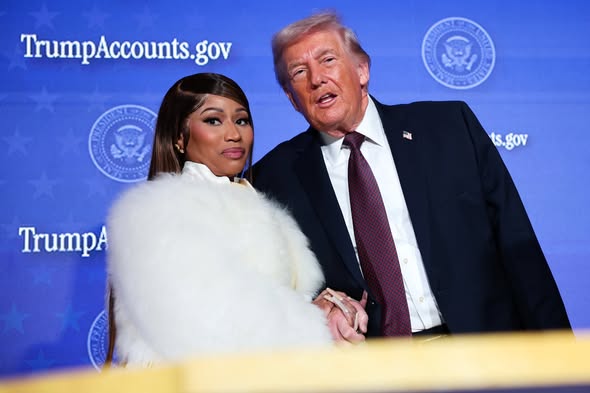
WASHINGTON, DC – JANUARY 28: Musician Nicki Minaj (L) joins U.S. President Donald Trump on stage as he delivers remarks during the Treasury Department’s Trump Accounts Summit at Andrew W. Mellon Auditorium on January 28, 2026 in Washington, DC. “Trump Accounts” are a portion of recently passed tax and spending legislation where the federal government will deposit $1,000 into investment accounts for every child born between 2025 and 2028 once parents sign their children up while filing their income taxes.
Trinidadian-American rapper Nicki Minaj has sparked widespread controversy and debate after publicly declaring herself to be Donald Trump’s “number one fan”, marking a dramatic political turn for one of the most influential figures in global hip-hop. The declaration was made during a high-profile appearance in Washington, D.C., where the US President invited Minaj onto the stage following her vocal endorsement of the administration’s newly announced “Trump Accounts” initiative, a government-backed trust fund program for children.
The moment quickly went viral, amplified by images of Minaj holding what she described as a Trump “gold card” visa, a residency scheme promoted by the Trump administration that offers applicants permanent residency in the United States and a pathway to citizenship. The program has been marketed as a way to attract wealthy individuals and investors to the US, and its promotion by a celebrity of Minaj’s stature has pushed it into the global spotlight.
Minaj’s public alignment with Trump represents a striking shift from her earlier political positions. In the past, she had been openly critical of Trump’s hardline immigration policies, particularly those targeting undocumented migrants and asylum seekers. The rapper has previously spoken about her own background, noting that she moved to the United States from Trinidad and Tobago with her parents as a child, a personal history that made her recent praise of Trump’s leadership especially surprising to many fans and commentators.
A surprise appearance on a political stage
Minaj’s appearance came during an event focused on the promotion of Trump Accounts, a policy initiative designed to provide government-seeded investment accounts for children. The accounts, according to the administration, aim to encourage long-term savings, financial literacy, and wealth-building for future generations. Supporters argue that the program could help narrow economic disparities, while critics have dismissed it as a politically branded policy designed to appeal to families ahead of future elections.
After Minaj publicly voiced her support for the initiative, Trump invited her onto the stage, praising her influence and thanking her for backing the program. In front of an audience of political figures, donors, and media, Minaj described herself as Trump’s most loyal supporter and encouraged parents to take advantage of the trust fund scheme.
The optics of the moment were striking: a global music icon standing alongside a deeply polarizing president, smiling for cameras and celebrating a policy initiative bearing Trump’s name. Within hours, clips and images of the appearance were circulating widely on social media, prompting intense reactions across political and cultural lines.
The “gold card” visa and questions of privilege
Perhaps even more controversial than Minaj’s endorsement was her display of the Trump “gold card” visa, a residency program that offers permanent legal status to individuals who meet certain financial thresholds. The visa has been promoted as a way to attract high-net-worth individuals to invest in the US economy, offering an expedited route to residency and eventual citizenship.
Minaj’s decision to showcase the card publicly drew immediate scrutiny. Immigration advocates and critics of the administration questioned the fairness of a system that appears to prioritize wealth over humanitarian or family-based immigration pathways. For many, the image of a wealthy celebrity celebrating fast-tracked residency stood in stark contrast to the experiences of migrants facing detention, deportation, or prolonged legal uncertainty.
The controversy was intensified by Minaj’s own immigration story. Having previously spoken about arriving in the US as a child, her embrace of a policy that critics say reinforces a two-tier immigration system—one for the wealthy and another for everyone else—has been described by some as contradictory and deeply disappointing.
From critic to supporter
Minaj’s political evolution has become a focal point of the debate. During Trump’s earlier years in office, she had aligned herself more closely with criticism of his immigration stance, echoing concerns about family separations and aggressive enforcement tactics. Her recent praise of Trump’s leadership, however, suggests a reassessment of his presidency, or at least of specific policies she now supports.
In recent statements, Minaj has emphasized themes of economic opportunity, financial independence, and what she described as “strong leadership.” Supporters argue that her focus on programs benefiting children and families reflects a pragmatic approach rather than ideological loyalty. Critics, meanwhile, accuse her of overlooking the broader consequences of the administration’s policies, particularly on marginalized communities.
The rapper has not shied away from the backlash. In social media posts following the event, she dismissed criticism as politically motivated and accused detractors of attempting to silence dissenting views. Her comments further fueled debate about celebrity influence in politics and the responsibilities that come with such a large platform.
Timing amid national unrest
Minaj’s endorsement comes at a particularly volatile moment in the United States. Across several cities, protests have erupted following incidents in which Immigration and Customs Enforcement (ICE) agents were involved in fatal shootings of US citizens. These cases have intensified scrutiny of federal immigration enforcement and reignited long-standing debates over the use of force, accountability, and the role of immigration agencies operating within US communities.
Demonstrations have drawn attention to what activists describe as a pattern of aggressive tactics by ICE and other federal agents. Protesters argue that recent incidents highlight systemic problems in enforcement practices, while government officials have called for investigations and urged calm as inquiries continue.
Against this backdrop, Minaj’s celebration of a Trump-branded immigration benefit has struck many as jarring. For critics, the contrast between a celebrity receiving privileged access to residency and communities mourning the deaths of citizens in enforcement operations underscores what they see as deep inequalities in the system.
Political and cultural reactions
Reactions to Minaj’s comments have been swift and polarized. Some supporters have praised her for speaking openly about her political views and for backing a program aimed at helping children financially. Others have framed her endorsement as an example of independent thinking in an era of rigid political alignment.
However, a significant portion of her fan base has expressed disappointment or anger. Online discussions have highlighted her previous criticism of Trump’s policies, questioning what they see as a reversal driven by personal benefit rather than principle. Hashtags calling out perceived hypocrisy trended alongside hashtags defending her right to political expression.
Political figures have also weighed in, with some Republicans welcoming her support as evidence of growing cultural backing, while Democrats and immigration advocates have cited her comments as emblematic of what they view as the administration’s focus on optics and celebrity endorsements rather than substantive reform.
Celebrity power and political messaging
Minaj’s involvement highlights the increasingly blurred line between entertainment and politics. Celebrities have long played a role in shaping public opinion, but the direct association between a major music star and a sitting president’s immigration and financial initiatives has raised fresh questions about influence and accountability.
Supporters argue that celebrities can help bring attention to policy initiatives that might otherwise be ignored. Critics counter that such endorsements risk oversimplifying complex issues and lending credibility to policies without adequate scrutiny.
In Minaj’s case, her endorsement has undeniably amplified awareness of Trump Accounts and the gold card visa. Whether that attention translates into broader public support—or deeper skepticism—remains to be seen.
A moment that reflects deeper divisions
Ultimately, the controversy surrounding Nicki Minaj’s declaration of loyalty to Donald Trump reflects broader divisions within American society. Immigration, wealth inequality, law enforcement, and the role of celebrity influence are all intersecting in a single, highly visible moment.
For some, Minaj’s stance represents empowerment and financial opportunity. For others, it symbolizes privilege, contradiction, and insensitivity at a time of national tension and grief. As protests continue and debates over immigration enforcement intensify, her endorsement has become more than a celebrity headline—it has become a lens through which deeper political and cultural conflicts are being examined.
Whether Minaj’s political shift marks a lasting realignment or a momentary alliance remains uncertain. What is clear is that her words and actions have reignited conversations about who benefits from immigration policy, how wealth shapes access, and how public figures influence political discourse in an already polarized nation.

