


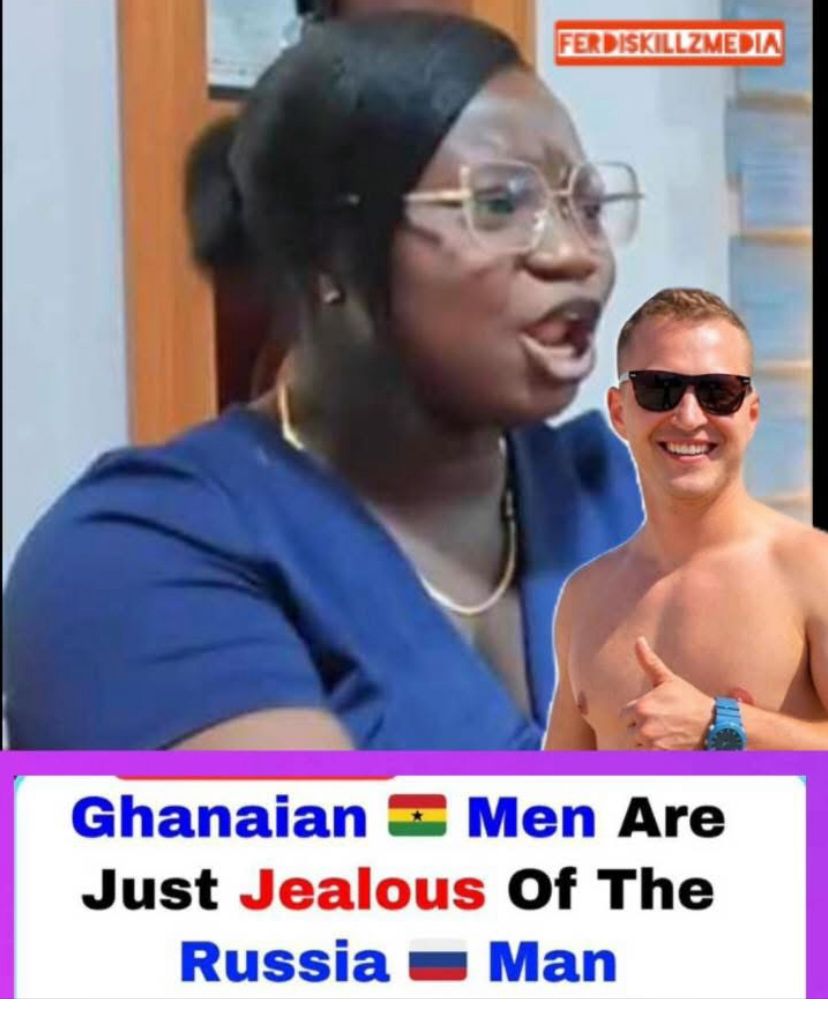
A viral social media graphic claiming that “Ghanaian men are just jealous of the Russian man” has ignited widespread debate across digital platforms, prompting conversations about relationships, national identity, stereotypes, and the power of online narratives. The meme-style post, which features a studio image of a Ghanaian woman speaking alongside a cut-out photo of a smiling white man identified as Russian, has been shared extensively across Facebook, Instagram, TikTok, and WhatsApp groups.
While the post appears to have been designed for entertainment and engagement, its bold wording has drawn serious reactions from users who see it as part of a growing trend of sensational online commentary about cross-cultural relationships.
Table of Contents
ToggleHow the Debate Started
The viral image includes a prominent caption suggesting that Ghanaian men are “jealous” of a Russian man. The framing implies a comparison between local Ghanaian men and a foreign suitor, sparking immediate reactions from viewers who interpreted the message in different ways.
Some users viewed the post as humorous banter. Others considered it divisive, arguing that it unfairly paints Ghanaian men in a negative light while elevating a foreign national as superior. Within hours of being widely circulated, comment sections filled with passionate opinions, memes, counterarguments, and personal testimonies.
Digital culture analysts say this type of content is designed to provoke strong emotional responses, which in turn drives engagement.
“When posts compare groups of people in exaggerated ways, they often go viral because they tap into pride, insecurity, and identity,” said a Ghana-based social media strategist who requested anonymity. “The stronger the emotional reaction, the more shares and comments you get.”
National Identity and Social Media
In Ghana, discussions about relationships involving foreign nationals have been trending topics for years. From celebrity marriages to viral dating stories, social media users frequently weigh in on who is dating whom—and why.
However, experts note that sweeping generalizations about entire groups can oversimplify complex social realities.
Sociologist Dr. Kwame Mensah explains that national pride is deeply rooted in many societies.
“When people see statements suggesting that their men—or women—are inferior to outsiders, it can trigger defensiveness,” he said. “But we must remember that social media posts often exaggerate for effect. They are not scientific assessments.”
Indeed, many commenters were quick to point out that jealousy is an individual emotion, not a national characteristic.
The Role of Viral Content
The structure of the viral image follows a familiar formula in online culture: a bold claim, a national comparison, and visual elements designed to capture attention. The use of flags, bright colors, and expressive imagery makes the post highly shareable.
Content creators often employ this format because it encourages debate. And debate, whether positive or negative, increases visibility through platform algorithms.
Marketing consultant Abena Ofori notes that controversy has become a common strategy in digital engagement.
“Posts that compare cultures or nationalities almost always trend,” she said. “They create a ‘team versus team’ dynamic. People feel compelled to defend their side.”
However, she cautions that such tactics can have unintended consequences, including reinforcing stereotypes or deepening social divisions.
Public Reactions: Mixed and Passionate
Scrolling through comment sections reveals a wide spectrum of reactions.
Some Ghanaian men dismissed the claim as baseless and humorous. Others expressed frustration, arguing that the post disrespects local men who work hard to build relationships and families.
Meanwhile, some women used the opportunity to share their own experiences dating both local and foreign partners. Many emphasized that compatibility, respect, and shared values matter more than nationality.
“I think it’s not about being Ghanaian or Russian,” one commenter wrote. “It’s about character.”
Another user added: “Let’s stop making everything about nationality. Good men exist everywhere.”
Cross-Cultural Relationships in Ghana
Ghana has long been known for its hospitality and vibrant multicultural communities. As tourism, business, and international education continue to grow, cross-cultural relationships are becoming more visible.
According to social observers, these relationships can sometimes attract attention because they challenge traditional expectations.
“In the past, communities were more homogeneous,” Dr. Mensah explained. “Now globalization has made cross-border connections common. But society is still adjusting to that visibility.”
While many Ghanaians celebrate diversity and international connections, online commentary sometimes magnifies isolated stories into broader narratives.
The Impact of Stereotypes
The phrase “Ghanaian men are jealous” reduces millions of individuals to a single trait. Similarly, portraying a “Russian man” as uniquely desirable can perpetuate unrealistic assumptions.
Psychologists warn that repeated exposure to generalized narratives can shape perceptions over time.
“When stereotypes are repeated frequently, even in humorous formats, they can influence how people view themselves and others,” said clinical psychologist Ama Serwaa.
She emphasized the importance of critical thinking when consuming viral content.
“Ask yourself: Is this statement supported by evidence? Or is it designed to provoke?”
Digital Responsibility and Media Literacy
The viral debate underscores a broader issue: the need for digital literacy in the age of rapid information sharing.
Media experts encourage users to pause before reacting emotionally to provocative content. Verifying sources, understanding context, and recognizing satire are key skills in navigating today’s digital landscape.
“In many cases, these posts are not official statements or researched claims,” Ofori said. “They are simply designed for engagement.”
Platforms themselves have also encouraged respectful discourse, reminding users to avoid harassment or hate speech in comment sections.
Turning Controversy Into Conversation
Despite the heated reactions, some community leaders see an opportunity for constructive dialogue.
Relationship counselor Nana Yaa Asante believes the debate could open meaningful discussions about expectations in modern partnerships.
“Instead of focusing on nationality, we should talk about qualities that make relationships healthy—communication, respect, emotional maturity,” she said.
She added that comparisons often stem from insecurity rather than reality.
“When we compare ourselves to others, especially based on limited information, it rarely leads to positive outcomes.”
The Broader Lesson
The viral claim may fade as quickly as it rose, replaced by the next trending topic. But the underlying themes—identity, pride, love, and comparison—remain relevant.
In an interconnected world, narratives travel fast. A single image can spark national conversations within hours. The key question is how audiences respond.
Will debates remain respectful? Will stereotypes be challenged? Or will divisions deepen?
Many users have already shifted the tone by emphasizing unity and mutual respect.
“We are all human first,” one commenter wrote. “Let’s celebrate love wherever it comes from.”
A Reminder About Individuality
At its core, the debate highlights a simple truth: individuals cannot be defined by nationality alone.
There are confident and insecure people in every country. There are loyal partners and unreliable ones across all cultures. Human behavior cannot be reduced to a single label.
By recognizing this complexity, social media users can move beyond reactive arguments toward more thoughtful discussions.
Conclusion
The viral “Ghanaian men and Russian man” graphic demonstrates the powerful influence of digital storytelling. While some view it as harmless humor, others see it as a reminder of how quickly stereotypes can spread.
As conversations continue, experts encourage empathy, critical thinking, and responsible engagement online.
In the end, the most productive takeaway may be this: relationships thrive not on nationality or comparison, but on shared values, understanding, and respect.
And in a world increasingly connected by screens and stories, choosing constructive dialogue over division may be the most important response of all.
Related posts:
- SHS 2 Student Allegedly Impregnates ICT Teacher During National Service: What We Know So Far
- GCB Bank eyes cross-border takeover as profits soar and dividend returns
- The first group of 2026 Ghanaian pilgrims left Tamale heading to Mecca.
- Bole SHS Teacher And Student Caught At the scince Lab Having S3x

