


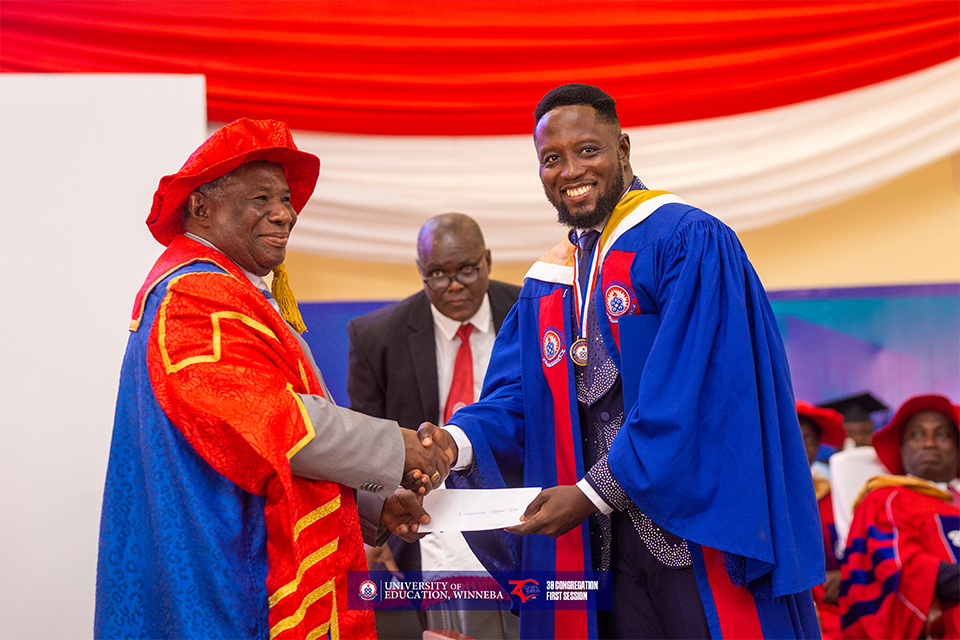
Mr. Lawrence Gyasi Senior, valedictorian of the 2025 graduating class of the University of Education, Winneba (UEW), has delivered a deeply moving and intellectually charged valedictory address that celebrated resilience, challenged long-held misconceptions about Ghanaian languages, and called on graduates to become cultural guardians and innovators in a rapidly changing world.
Speaking on Thursday, 27th November 2025, at the Jophus Anamuah-Mensah Conference Centre during the First Session of UEW’s 30th Congregation, Mr. Gyasi described the occasion as the culmination of years marked by sacrifice, transformation, perseverance, and the triumph of determined spirits over adversity. His address resonated powerfully with graduates, faculty, administrators, parents, and dignitaries gathered to witness the historic ceremony.
Standing before a distinguished audience, Mr. Gyasi expressed profound gratitude for the privilege of speaking on behalf of his colleagues. He described the ceremony as an unforgettable moment—one that affirmed the enduring belief that education possesses the power not only to transform individual lives but also to shape entire communities, influence national development, and inspire future generations.
According to him, the joy and fulfilment felt by the graduating class on that day overshadowed memories of long nights of study, relentless academic pressures, and the demanding experiences that had defined their journey. He reminded his colleagues that every smile in the auditorium carried a story of perseverance, discipline, and quiet determination.
Reflecting on the beginning of their academic journey in 2022, Mr. Gyasi recalled how their entry into university life coincided with one of the most disruptive periods in recent academic history. The nationwide strike by the University Teachers Association of Ghana (UTAG) brought academic activities to a halt, forcing students to return home for more than a month. For many, this sudden interruption shattered the excitement and expectations that accompanied their admission into the University.
The uncertainty that followed, he explained, was emotionally draining. Students who had barely begun to settle into campus life found themselves grappling with anxiety, disrupted academic plans, and concerns about delayed graduation. When academic activities eventually resumed, the transition to virtual learning through the University’s V-Class platform introduced a new layer of complexity.
Mr. Gyasi noted that adapting to online lectures, digital assessments, and self-directed learning tested the resilience, patience, and discipline of the entire cohort. Issues of internet connectivity, access to devices, and unfamiliarity with virtual learning tools posed additional challenges. Yet, in the face of these difficulties, the class of 2025 demonstrated remarkable adaptability and resolve.
Despite the setbacks, students refocused, reorganised their priorities, and pushed forward—an early sign of the grit and perseverance that would later come to define the graduating class. He described this period as a formative experience that instilled in them the ability to navigate uncertainty and remain committed to their goals regardless of circumstances.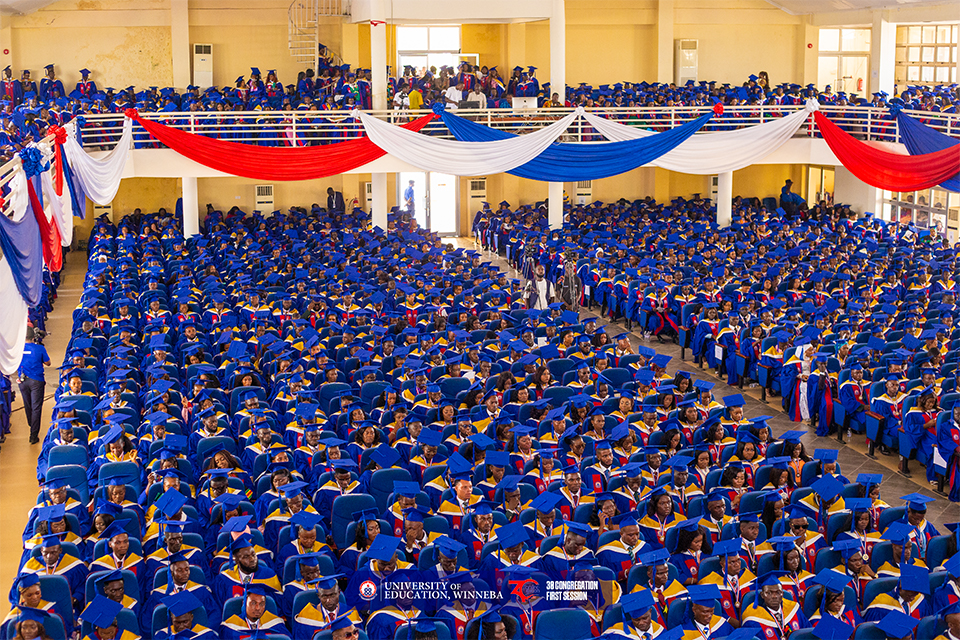 ed a deeply personal story that shaped his academic path and ignited his passion for Ghanaian languages. He revealed that in 2020, while working in a media environment, he corrected a colleague’s misuse of a Twi expression during a news broadcast. Instead of being acknowledged, he was dismissed and publicly humiliated, an experience that shook his confidence in his linguistic competence.
That painful moment, however, became a turning point. Rather than retreating, Mr. Gyasi resolved to deepen his mastery of the Twi language and to pursue it formally at the University. What began as an attempt to reclaim personal confidence evolved into a powerful academic and intellectual mission.
He recounted how his decision to study Twi at the University was met with widespread scepticism. Many questioned his choice, insisting that Ghanaian languages offered limited career prospects and were suitable only for students perceived as less academically capable. He described these perceptions as deeply misguided, harmful, and rooted in colonial legacies that continue to undermine indigenous knowledge systems.
Challenging these stereotypes, Mr. Gyasi emphasised that the study of Ghanaian languages demands a high level of intellectual engagement, critical analysis, historical understanding, and academic discipline. He argued that language is not merely a tool for communication but a repository of culture, philosophy, identity, and worldview.
Ironically, he noted, his early experiences in the programme humbled him significantly. In his first two quizzes, he scored very low, an outcome that forced him to confront the gap between passion and performance. Yet, instead of yielding to discouragement, he embraced the experience as a lesson in humility and growth.
He explained that these early setbacks taught him that excellence is not a product of natural talent alone but the result of intentional effort, consistency, resilience, and the willingness to learn from failure. Through dedication and perseverance, he steadily improved, ultimately emerging as the valedictorian of his graduating class.
Speaking on behalf of the class of 2025, Mr. Gyasi extended heartfelt gratitude to all faculties, departments, and lecturers across the University for their tireless commitment to academic excellence. He acknowledged their role in shaping students into confident, knowledgeable, and impactful graduates equipped to contribute meaningfully to society.
He also recognised the vital support of University administrators whose guidance, encouragement, and firm leadership helped sustain academic standards and student welfare during challenging periods. According to him, the collective efforts of academic and administrative staff formed the backbone of the students’ success.
In an emotional tribute, Mr. Gyasi paid special homage to parents, guardians, mentors, and family members whose sacrifices, prayers, and emotional investment sustained students through moments of doubt and hardship. He acknowledged that behind every graduate stood individuals who had given selflessly—financially, emotionally, and spiritually—to ensure their success.
He expressed particular appreciation to his twin brother, Lawrence Gyasi Junior, whose constant support and companionship strengthened him throughout the journey. He also acknowledged Mrs. Lydia Dzekle and his extended family for their unwavering encouragement, guidance, and belief in his potential.
In one of the most spirited moments of his address, Mr. Gyasi invited his fellow graduands to pause and recognise the resilience that had carried them through economic hardships, the global COVID-19 pandemic, demanding coursework, early morning mid-semester examinations, internship pressures, project work, labour-related disruptions, and numerous personal struggles.
He reminded them never to underestimate the significance of their journeys or the strength they had demonstrated. According to him, graduation was not merely an academic milestone but a historic moment that symbolised survival, growth, and transformation.
Mr. Gyasi encouraged the class to leave the University with a shared identity as “torchbearers from UEW”—individuals entrusted with the responsibility of carrying knowledge forward, preserving culture, and serving as architects of national development.
He articulated a compelling vision for the future of Ghana, one in which children grow up confidently grounded in their mother tongue, using their linguistic and cultural heritage as a foundation for cognitive development, creativity, and innovation. He argued that indigenous languages should no longer be treated as barriers to progress but recognised as powerful vehicles for identity, intellectual growth, and economic opportunity.
According to him, proficiency in Ghanaian languages, when combined with expertise in other academic disciplines, has the potential to fuel vibrant cultural industries, creative economies, education systems, and technological innovations that uplift communities and strengthen national cohesion.
Mr. Gyasi warned graduates against becoming strangers within their own cultural spaces. He urged them to integrate cultural knowledge with modern innovation, ensuring that development does not come at the cost of identity. In his view, true progress lies in harmonising tradition and modernity.
As he concluded, Mr. Gyasi called on the graduating class to step into the world with courage, integrity, and a clear sense of purpose. He reminded them that they had been prepared not only for personal success but also for service to humanity.
Carrying forward the values, discipline, and intellectual strength imparted by the University of Education, Winneba, he urged his colleagues to lead with empathy, creativity, and responsibility. In doing so, he said, they would honour their journey, their institution, and the generations that would follow in their footsteps.

