What If the World’s Largest Snake Was Still Alive?
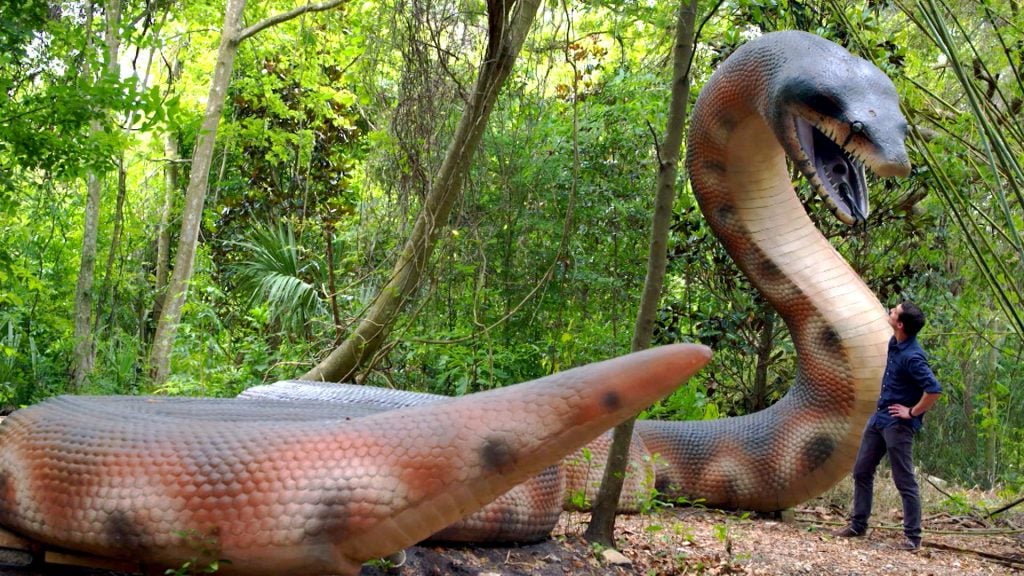
More than 60 million years ago, long before humans walked the Earth, a serpent of unimaginable size ruled the tropical swamps of South America. That snake was Titanoboa cerrejonensis, the largest snake ever discovered. Stretching up to 42–50 feet (12–15 meters) and weighing over a metric ton, Titanoboa was not just big — it was a biological marvel.
But what if Titanoboa had survived extinction? What if, hidden in remote rainforests, the world’s largest snake was still alive today?
The answer would transform ecosystems, science, tourism, and even human psychology. Let’s explore what our world might look like if this prehistoric giant still slithered through modern rivers.
A Giant from a Warmer World
Titanoboa lived during the Paleocene epoch, a time when Earth’s climate was much warmer than today. Tropical temperatures were significantly higher, allowing cold-blooded reptiles to grow to enormous sizes.
Scientists discovered Titanoboa fossils in Colombia’s Cerrejón coal mines in 2009. From vertebrae measurements, researchers estimated its extraordinary size — far exceeding any living snake today.
For comparison, the largest living snake species, the Green anaconda, can grow up to 30 feet long and weigh over 250 kilograms. Even that seems small compared to Titanoboa.
If Titanoboa were alive today, it would immediately reclaim the title of Earth’s most formidable reptilian predator.
Where Would It Live?
Because Titanoboa was ectothermic (cold-blooded), it required warm temperatures to maintain its metabolism. Today, its most suitable habitats would likely be:
-
The Amazon rainforest
-
The Orinoco River Basin
-
Central African wetlands
-
Southeast Asian tropical floodplains
Dense vegetation, slow-moving rivers, and swamps would provide ideal camouflage and ambush hunting opportunities.
However, today’s global temperatures are cooler than during Titanoboa’s era. Scientists believe its massive size was partly possible because ancient equatorial temperatures averaged 30–34°C (86–93°F). Modern climate conditions might limit its size slightly — unless ongoing climate change recreates similar thermal conditions.
If global temperatures continue rising, regions previously too cool for Titanoboa could potentially become suitable habitats.
Apex Predator of the Modern Era
If Titanoboa existed today, it would dominate freshwater ecosystems.
Much like the Saltwater crocodile rules estuaries and coastal rivers, Titanoboa would reign supreme in inland waterways.
Its diet might include:
-
Large mammals such as capybaras, deer, and tapirs
-
Crocodilians
-
Wild pigs
-
Possibly even jaguars
The Jaguar, currently one of the Amazon’s top predators, might face unexpected competition.
Titanoboa would likely be an ambush predator. It would wait partially submerged in murky waters before striking with immense speed. Its constriction force — potentially several tons of pressure — could crush bones and suffocate prey within minutes.
Entire ecosystems would adapt around its presence.
Impact on Biodiversity
A predator of that size would regulate prey populations significantly. Certain large herbivores might decline, altering vegetation growth patterns. Competing predators could be displaced.
In ecological terms, Titanoboa would function as a keystone species — an organism whose presence disproportionately shapes its environment.
However, such dominance might also create tension in modern conservation systems. Protected wildlife areas would need additional safety protocols. Researchers entering wetlands would require armed escorts and tracking equipment.
Human Encounters: Rare but Dramatic
Titanoboa would likely avoid humans, much like large anacondas do today. But encounters would be inevitable.
Imagine fishermen reporting a 45-foot serpent capsizing boats. Satellite footage capturing a massive thermal signature moving through flooded forest. Viral drone videos circulating worldwide.
Governments would issue advisories in high-risk regions. Livestock farmers near rainforest edges might suffer losses. Insurance industries might even adjust risk assessments in certain areas.
Despite fear, fascination would follow. Titanoboa would instantly become the most famous animal on Earth.
Scientific Breakthroughs
If Titanoboa were alive, it would revolutionize science.
Researchers would study:
-
How its heart pumps blood across such a massive body
-
How its lungs function efficiently at enormous scale
-
Its metabolic adaptation to temperature
-
Its genetic blueprint
Its existence could reshape understanding of reptilian gigantism and evolutionary biology.
Medical researchers might even study its muscle fibers for breakthroughs in strength and endurance science.
Natural history museums would collaborate globally to observe it in controlled environments — though housing such a creature in captivity would be nearly impossible.
Climate Change Connection
Interestingly, Titanoboa’s survival could be linked to climate change.
Warmer global temperatures may increase reptile growth potential. If Earth continues heating, tropical megafauna might grow larger over generations.
Titanoboa’s existence would serve as a living indicator of climate conditions — a biological thermometer of global warming.
However, climate instability, deforestation, and pollution could also threaten its survival.
Economic and Tourism Boom
Countries hosting Titanoboa populations would experience a tourism surge similar to African safaris.
Eco-tour operators might organize “Giant Serpent Expeditions” in controlled zones. Wildlife documentaries would compete for exclusive footage.
Streaming platforms and filmmakers would invest heavily in Titanoboa content. It would surpass lions and sharks in public fascination.
Yet strict conservation laws would likely regulate access, preventing exploitation.
Could Modern Society Protect It?
Today’s world is fragmented by highways, agriculture, and urban expansion. Even powerful predators like tigers struggle against habitat loss.
Titanoboa would require vast territories of undisturbed wetlands. Conservation organizations would push for expanded rainforest protections.
If governments failed to act, poaching and habitat destruction could drive Titanoboa toward extinction again.
Ironically, the world’s largest snake might become one of its most vulnerable species.
Psychological and Cultural Impact
Human culture would transform around Titanoboa’s existence.
Mythology would blend with reality. Indigenous traditions might elevate it to sacred status. Horror films would pale in comparison to real footage.
Children would grow up learning about Titanoboa alongside lions, elephants, and whales.
Its existence would remind humanity that we are not always the dominant physical force on the planet.
Would It Be Dangerous to Humans?
Statistically, attacks would likely be rare. Even modern anacondas seldom attack humans.
However, a 1-ton constrictor has the capability to overpower a person easily. Authorities would treat Titanoboa habitats as high-risk wilderness zones.
Safety protocols might include:
-
Mandatory armed wildlife patrols
-
Satellite tagging of individuals
-
Real-time monitoring systems
-
Strict buffer zones around settlements
Public awareness campaigns would emphasize avoidance rather than fear.
A Living Link to Prehistory
Titanoboa’s continued existence would blur the line between prehistoric Earth and the present day.
While dinosaurs vanished 66 million years ago, Titanoboa lived shortly after their extinction. Its survival would make Earth feel less distant from its ancient past.
Standing beside a 45-foot serpent would feel like looking back in time.
Conclusion
If Titanoboa cerrejonensis were still alive today, our world would be wilder, more cautious, and infinitely more fascinating.
Rainforests would hold a predator beyond imagination. Scientists would gain unprecedented biological insights. Governments would balance conservation with public safety. Tourism industries would boom. Climate discussions would gain a living symbol of prehistoric warmth.
Above all, humanity would be reminded that nature’s power far exceeds our expectations.
The age of giants may be gone — but imagining their survival reveals just how extraordinary our planet truly is.