


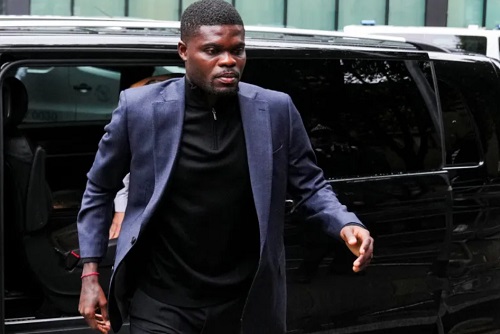
Ghanaian international footballer Thomas Partey has reportedly been charged with additional counts of rape, deepening the legal troubles surrounding the former Premier League midfielder and drawing renewed public attention to the case. The latest development marks a significant escalation in proceedings that have been under investigation for some time.
According to reports, the new charges follow ongoing inquiries by UK law enforcement authorities into allegations made by multiple complainants. The case has generated widespread discussion both within the football community and beyond, given Partey’s prominence as a professional athlete and his role as a senior figure in Ghana’s national team setup.


Partey, who previously played for Arsenal F.C. in the English Premier League and earlier for Atlético Madrid, has consistently denied wrongdoing in relation to earlier allegations. The additional counts now brought against him reportedly stem from further evidence reviewed by prosecutors, although detailed specifics of the charges have not yet been fully disclosed in public court documents.
Legal experts note that the addition of further counts in such cases typically follows extended investigations, including the examination of witness statements, digital communications, forensic material, and other corroborative evidence. Prosecutors must determine whether there is sufficient evidence to meet the threshold required to proceed formally with charges.
The case is being handled under the UK legal system, where individuals charged with serious offences such as rape are entitled to the presumption of innocence until proven guilty in court. The matter is expected to proceed through the criminal justice process, potentially involving preliminary hearings before moving to trial if the case is not dismissed or resolved earlier.
The allegations have inevitably impacted Partey’s professional career. During earlier stages of the investigation, his club maintained a cautious approach, often refraining from public comment beyond acknowledging awareness of the matter. Football clubs in such circumstances frequently rely on legal guidance to balance contractual obligations, safeguarding responsibilities, and respect for due process.
In Ghana, the news has sparked intense public reaction. Partey has long been regarded as one of the country’s most accomplished football exports, having established himself in top-tier European football. His performances for the national team have earned him recognition and admiration among supporters. As a result, developments in the case have resonated strongly with Ghanaian fans and the broader sporting community.
Advocacy groups focusing on sexual violence have emphasized the importance of allowing the legal process to run its course while ensuring that complainants receive appropriate support. They stress that cases involving public figures should not deter victims from reporting alleged offences and that institutions must handle such matters with seriousness and sensitivity.
The addition of further counts suggests that prosecutors believe the evidence warrants expanding the scope of the case. However, legal analysts caution against drawing conclusions before the judicial process unfolds. In criminal proceedings, the burden of proof rests on the prosecution, which must establish guilt beyond a reasonable doubt.
Should the case proceed to trial, it could involve detailed examination of timelines, communications, and the credibility of testimonies from all parties involved. Trials in cases of this nature often attract significant media attention, particularly when high-profile individuals are implicated.
The situation also raises broader questions about professional sports governance. Football associations and clubs have faced increasing scrutiny in recent years regarding how they address allegations of misconduct involving players. Policies related to safeguarding, player conduct, and interim suspensions vary across jurisdictions and competitions.
For Partey, the immediate priority will likely be mounting a legal defense against the charges. Defendants in such cases typically work closely with legal counsel to prepare responses to the allegations and to challenge the prosecution’s evidence where appropriate. The process can be lengthy, often extending over many months.
Meanwhile, football authorities may monitor developments closely to determine whether any regulatory actions are necessary under their codes of conduct. Decisions in this regard are usually guided by both legal advice and internal disciplinary frameworks.
Public reaction has been divided. Some supporters have urged patience and restraint, emphasizing the principle of innocent until proven guilty. Others have expressed concern about the seriousness of the allegations and the implications for the sport’s image.
In cases involving sexual offence charges, courts often impose reporting restrictions to protect the identities of complainants. As such, media coverage may be limited in certain respects until formal proceedings take place in open court.
The coming weeks are expected to provide greater clarity regarding the next legal steps. If the charges are formally read in court, a timetable for subsequent hearings may be established. The prosecution will outline its case, while the defense will have the opportunity to respond.
For now, the addition of further counts represents a pivotal development in a case that continues to unfold. While the legal process moves forward, observers across the football world and beyond will be watching closely.
It is important to reiterate that, under the law, being charged with an offence does not equate to guilt. The court will ultimately determine the outcome based on the evidence presented. Until then, the matter remains subject to judicial consideration, and all parties are entitled to fair and impartial proceedings.
Related posts:
- Viral Claim Sparks Debate: Woman Says Pastor’s Prophecy Influenced Her Relationship Decision
- Morocco win AFCON 2025 in dramatic twist as CAF hands Senegal 3-0 forfeit
- Black Stars: Havertz returns, Musiala out as Germany prepare for Ghana showdown
- Ghana ring 4 changes as Partey returns to face England in World Cup showdown Kweku Zurek Sports News Jun – 23 – 2026 , 19:26 2 minutes read

