


In the bustling corridors of Achimota School in Accra, a young boy with dreadlocks and an insatiable curiosity once asked a question few people around him could answer: “What is inside a computer that makes it think?”
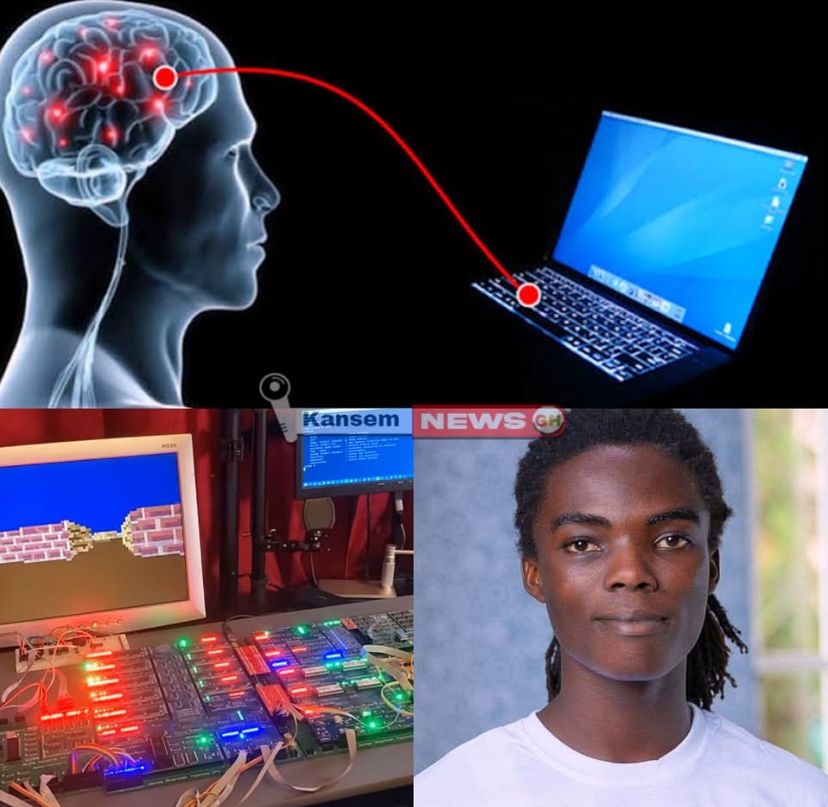
Today, that same boy — now a young man studying in the United States — has done more than just ask. He has created a working computer “brain” from scratch, painstakingly designing the circuit logic and thousands of individual transistors by hand. This is the story of Tyrone Iras Marhguy, a Ghanaian prodigy whose journey from a classroom in Accra to an engineering project that bridges art and science embodies the spirit of innovation, resilience, and cultural pride. 
Early Life: Roots in Ghana and a Curious Mind
Tyrone’s story begins in Ghana, where he grew up with a deep curiosity for how things worked. Even as a child, he was drawn to puzzles, mechanical toys, and anything electrical. Instead of being satisfied with the finished product, his attention was captured by the hidden layers beneath — the circuits, the logic, the unseen patterns that made gadgets come alive.
His early education culminated at Achimota Senior High School, one of Ghana’s most historic and prestigious secondary institutions known for producing leaders, thinkers, and innovators across many fields. Achimota has long prided itself on nurturing holistic education — from sciences and maths to arts and leadership — contributing to Ghana’s intellectual growth. 
However, Tyrone’s path at Achimota was not without its challenges.
The Dreadlocks Case: A Test of Identity and Rights
When Tyrone applied for admission to Achimota School, he was initially denied entry — not because of his academic record but because of his dreadlocks, a hairstyle tied to his Rastafarian faith and identity. This decision sparked widespread debate and ultimately led to a landmark court case in Ghana over religious freedom and the right to education. 
The High Court in Accra ruled in Tyrone’s favor, affirming that a student’s hair and religious expression should not be grounds for exclusion from education. This victory was not just personal; it became a symbol of broader issues of identity, culture, and rights in educational spaces. From that point on, Tyrone’s story was no longer just about a boy with questions — it became a narrative about courage, persistence, and standing up for what is right.
Once admitted, Tyrone excelled academically, especially in mathematics and science, achieving exemplary results in the West African Senior School Certificate Examination (WASSCE).  His success was a testament not just to his intellectual ability, but to the power of resilience in the face of adversity.
The Leap to the United States
Graduating from Achimota with outstanding results and a growing reputation, Tyrone attracted significant attention from universities around the world. Multiple institutions in the U.S. offered him scholarships collectively valued at over US$1 million, recognizing his academic promise and potential to contribute meaningfully to global technology and science. 
Ultimately, he chose to pursue Computer Engineering at the University of Pennsylvania (UPenn) — one of the United States’ top research universities. Here, he found himself immersed in a highly competitive academic environment, surrounded by some of the brightest young minds in the world.
Yet, it was not enough for Tyrone to just learn computer science at a high level. He wanted to understand it from the very ground up.
The Dorm Room Project: Building a Computer Brain
In his dorm room at UPenn, Tyrone embarked on a project that would soon redefine the way many students think about computers.
Most of us use computers every day — on phones, laptops, and gaming consoles — without knowing what happens inside their silicon hearts. Modern processors are made in billion-transistor configurations on chips that require multimillion-dollar fabrication plants. But Tyrone decided to go a different route.
He set himself the ambitious goal of building a working computer logic unit from scratch, starting at the level of individual transistors, the tiny electronic switches that form the foundation of all digital computing.
Over the course of more than 250 hours of design, testing, simulation, and verification, Tyrone successfully designed an 8-bit Arithmetic Logic Unit (ALU) with 3,488 discrete MOSFET transistors — each placed and connected by his own hand, with no professional fabrication equipment — a feat that astonished both his peers and professors. 
Why This Matters: The ALU and Transistors
To most people, the phrase “3,488 transistors” sounds abstract, but in computing, it is monumental. Every computer relies on billions of transistors working in harmony to perform calculations, run programs, and process data. Before microchips existed, computers were built from large discrete components — but today’s electronics rely on microscopic transistor arrays embedded on silicon wafers.
By building a working ALU using thousands of individual MOSFET transistors — and doing so without a chip fabrication lab — Tyrone did something that most engineers don’t attempt even with professional tools. He designed the logic that:
• Performs more than 19 different arithmetic and logical operations;
• Handles basic but crucial tasks like addition, subtraction, comparison, and decision logic;
• Was verified with more than 1.2 million test vectors, ensuring each path and outcome worked as intended. 
The ALU is essentially the brain’s reasoning center — where decisions are made and calculations happen. By building this by hand, Tyrone wasn’t just assembling a machine: he was reconstructing the very essence of computing logic.
⸻
The Process: Patience, Precision, and Passion
Tyrone’s project wasn’t built with pre-made chips or high-end laboratory tools. It began with basic textbooks on transistor physics, digital logic design, and circuit verification. He taught himself, step by step:
1. Understanding how MOSFET transistors behave at the electrical level;
2. Designing logic gates like AND, OR, XOR, NOT — the building blocks of digital computation;
3. Combining gates into functional modules, such as adders, subtractors, and control units;
4. Simulating circuits, identifying errors, and refining designs;
5. Verifying logic, ensuring that every combination of inputs produced correct outputs.
Such work demands not only intellect but patience — painstakingly checking each element and correcting mistakes that could cause the whole system to fail. It’s a kind of engineering craftsmanship that marries science with alchemy: turning abstract theory into tangible function, one transistor at a time.
Yet this process was about more than engineering. For Tyrone, it was an act of learning by doing — an immersive journey into the core of computing, far beyond writing code on a screen or executing programs in a classroom setting.
⸻
Why Tyrone’s Achievement Matters Globally
In a world where technology is often taken for granted, stories like Tyrone’s remind us of the beauty of understanding, not just using. Most people today interact with software, apps, and AI without ever thinking about what makes computers — the physical machines — actually work.
Tyrone’s ALU project is a powerful educational tool in itself:
• It demystifies how digital logic becomes physical reality;
• It inspires students to think deeper about technology;
• It encourages self-directed learning and innovation;
And perhaps most importantly, it shows that talent and perseverance can transcend limitations — whether social, cultural, or institutional.
Moreover, his story serves as a beacon for students back in Ghana and across Africa, where many young people dream of contributing to technology but lack role models or exposure. His work shows that even from modest beginnings, with curiosity and grit, one can reach the frontiers of engineering.
⸻
Beyond the Dorm Project: What’s Next
The current ALU design represents Phase One of Tyrone’s exploration. He plans to take the next steps:
• Optimizing the design for performance and stability;
• Assembling the circuitry onto a printed circuit board (PCB);
• Soldering and debugging physical hardware;
• Potentially designing a complete CPU or neuromorphic systems in the future. 
This is the point where theory meets reality — transforming a schematic into a physical piece of computing hardware that could eventually power real computation.
If successful, these future phases could contribute to areas like:
• Open-source hardware education, where learners can build and understand computing at the transistor level;
• Low-cost computing platforms for education in regions with limited access to advanced tools;
• New paradigms in computing architecture, especially as transistors reach nanoscale limits on commercial chips.
⸻
A Symbol of Identity and Possibility
For many Ghanaians, Tyrone’s journey resonates beyond science.
His rejection from Achimota because of his dreadlocks was not merely a disciplinary incident — it was a moment that captured public attention on cultural identity, religious expression, and educational access. From that experience emerged not frustration, but resolve. 
His success today is a powerful affirmation that who you are — your heritage, your beliefs, your appearance — does not limit what you can contribute to the world.
This adds a deeper cultural layer to his technical achievement — one that combines identity, rights, and the pursuit of knowledge in a way that inspires young people everywhere.
⸻
The Broader Impact: Inspiring a Generation
Tyrone’s work is already inspiring students, educators, and tech enthusiasts around the globe. It provides a narrative that:
• Encourages young Africans to pursue STEM fields boldly
• Reframes success not as borrowed excellence, but created excellence
• Challenges traditional educational models with hands-on, project-based learning
• Celebrates cultural identity as part of innovation, not an obstacle
His story connects with a wider community of remarkable Ghanaian scientists and engineers — from those who have advanced fiber optics, neuromorphic computing, and digital communications, to educators who challenge norms to open new doors for future innovators. 
⸻
Conclusion: The Journey Continues
From a young boy in Ghana asking questions about how computers work, to a student in Pennsylvania building a 3,488-transistor brain, Tyrone’s journey reflects the power of curiosity, courage, and relentless pursuit of knowledge.
As he continues to refine his designs, build physical hardware, and expand his understanding of computing systems, his story will continue to unfold — inspiring students and engineers across continents.
In a world where innovation often seems distant and inaccessible, Tyrone has shown that great discoveries begin with a simple question — and a willingness to chase the answer across borders, classrooms, and convention.

