


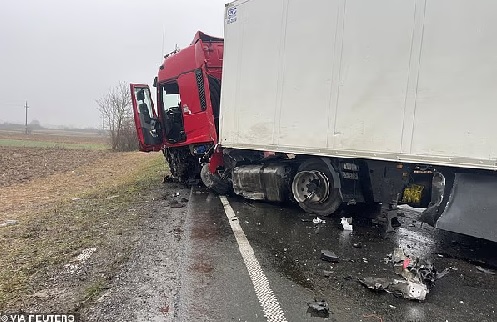
Seven supporters of Greek football club PAOK have been killed in a devastating road accident in Romania, casting a heavy shadow over European football and plunging the PAOK community into deep mourning. The fans were travelling to France to support their team in a UEFA Europa League fixture against Olympique Lyonnais when the tragedy occurred.
The crash took place at approximately 1:00 p.m. on Tuesday, when a minibus carrying 10 PAOK supporters was involved in a head-on collision with a lorry. According to initial reports, the impact was severe, leaving seven passengers dead at the scene. The remaining three occupants sustained serious injuries and were rushed to nearby hospitals, where they are currently receiving medical treatment.
Images released from the scene showed the horrifying aftermath of the collision. Both vehicles—the red-cabbed heavy goods truck and the minibus—were extensively damaged, with the front sections crushed almost beyond recognition. Debris was scattered across the roadway, and emergency responders worked for hours to secure the area and assist survivors.
A journey driven by loyalty and passion
The supporters were part of a small group of dedicated fans who had chosen to make the long journey across Europe to watch PAOK compete on the continental stage. For many football supporters, following a club abroad is more than entertainment—it is an expression of identity, loyalty, and lifelong commitment.
PAOK, based in Thessaloniki, has one of the most passionate fan bases in Greece. Known for their unwavering support, PAOK fans regularly travel long distances to back their team, often at great personal cost. The trip to France, while demanding, was seen as another chance to stand behind the club during a crucial European fixture.
What began as a journey filled with anticipation, camaraderie, and excitement ended in unimaginable tragedy.
The crash and emergency response
The collision occurred on a Romanian roadway frequently used by long-haul vehicles, as supporters made their way westward toward France. While authorities have not yet released full details regarding the cause of the crash, the head-on nature of the collision suggests a sudden and violent impact.
Emergency services arrived swiftly at the scene, including ambulances, police, and fire crews. Rescuers faced difficult conditions as they worked to extract victims from the wreckage. The severity of the damage meant that survival chances for many of the passengers were tragically limited.
The three survivors were stabilized on site before being transferred to medical facilities for urgent care. Hospital officials later confirmed that all three were in serious condition, though further updates on their prognosis have not yet been made public.
Romanian authorities launched a formal investigation into the crash, examining road conditions, vehicle integrity, and other potential contributing factors. Traffic in the area was temporarily halted, causing delays as investigators worked to document the scene.
Shockwaves across Greece and Europe
News of the accident spread rapidly across Greece and the wider football world. Social media platforms were flooded with messages of grief, disbelief, and solidarity from fans, clubs, and players across Europe.
For the PAOK community, the loss was especially profound. Many supporters knew the victims personally, either through fan groups, local clubs, or shared travel experiences. In Thessaloniki, news of the deaths brought spontaneous gatherings, candlelight vigils, and moments of silence.
Football clubs across Greece expressed their condolences, setting aside rivalries in recognition of the shared humanity that unites supporters beyond competition.
Statement from Greece’s Prime Minister
Greek Prime Minister Kyriakos Mitsotakis issued a statement expressing deep sorrow over the tragedy.
“I am deeply shaken by the tragic loss of Greek citizens in Romania,” he said, extending his “sincerest condolences to the families of the victims and the entire PAOK community.”
The Prime Minister also acknowledged the broader impact of the incident on Greek society, noting that the supporters were travelling peacefully to support their team and never anticipated such a fate. His office confirmed that Greek authorities were in contact with Romanian officials to assist with consular matters and to support the families affected.
PAOK and the football world respond
PAOK FC released a statement describing the victims as “members of our family,” emphasizing that the club’s identity is inseparable from its supporters.
“The pain is indescribable,” the club said. “These people lived and breathed PAOK. Their presence will be forever felt in our stands, our songs, and our hearts.”
The club announced plans to honor the deceased supporters at upcoming matches, with black armbands, moments of silence, and commemorative banners expected. Discussions were also underway regarding support for the families of the victims and the injured survivors.
UEFA and Olympique Lyonnais also expressed condolences, highlighting the tragedy as a reminder of the human dimension of football—a sport that connects millions but is ultimately sustained by individual lives and stories.
The culture of away travel in football
Away travel is an integral part of European football culture. Supporters routinely cross borders to follow their teams, forming a vibrant tapestry of chants, colors, and shared experiences. For many, these journeys are among the most meaningful aspects of fandom, creating memories that last a lifetime.
However, such travel also carries risks. Long road journeys, tight schedules, and unfamiliar routes can expose supporters to dangers that often go unnoticed until tragedy strikes. The Romania crash has renewed discussions about fan safety, travel planning, and the responsibilities of clubs, authorities, and supporter groups.
Some fan organizations have called for improved coordination and safety guidelines for long-distance travel, particularly for supporters crossing multiple countries.
The survivors and the long road ahead
While the loss of seven lives has understandably dominated attention, concern remains high for the three injured supporters who survived the crash. Hospitalized far from home, they face not only physical recovery but also psychological trauma.
Support networks, including Greek diplomatic services and PAOK fan associations, have mobilized to provide assistance. Families of the injured have travelled to Romania, while others await news anxiously from Greece.
Medical professionals stress that recovery from such severe accidents can be prolonged, requiring extensive rehabilitation and emotional support.
Mourning beyond football rivalries
One of the most striking aspects of the response has been the unity shown across football divides. Supporters of rival Greek clubs set aside differences to express condolences, acknowledging that tragedy transcends rivalry.
Messages of support also arrived from fan groups across Europe, many of whom understand the bonds formed during away trips and the risks involved. The sense of collective mourning highlighted football’s role as a shared cultural language, capable of bringing people together even in moments of immense sorrow.
Road safety and ongoing investigation
As investigations continue, authorities are expected to examine several factors, including driver behavior, road conditions, vehicle maintenance, and weather at the time of the crash. While no conclusions have yet been announced, officials emphasized the importance of a thorough and transparent process.
Road safety advocates have pointed out that long-distance travel involving small vehicles and heavy goods traffic remains a persistent risk across Europe. The collision has renewed calls for improved infrastructure, better enforcement of traffic regulations, and increased awareness of driver fatigue.
A match overshadowed by grief
The Europa League fixture between PAOK and Olympique Lyonnais, originally anticipated as a celebration of European competition, has been irreversibly overshadowed by tragedy. While decisions regarding match proceedings rest with UEFA, it is widely expected that the victims will be honored in some form.
For PAOK players and staff, the emotional burden is immense. Representing the club while knowing that supporters lost their lives en route to the match is a sobering reminder of the responsibilities carried by professional athletes beyond the pitch.
Remembering the victims
Though official identities have not yet been publicly released, those who knew the victims have described them as ordinary people united by extraordinary passion. They were workers, friends, family members, and lifelong supporters who chose to spend their time and resources following the club they loved.
In fan culture, such individuals are often remembered not just for their presence but for their voices, banners, and shared journeys. Memorials, chants, and tributes are expected to keep their memory alive in stadiums long after the immediate shock fades.
Grief, solidarity, and reflection
The deaths of the seven PAOK supporters serve as a painful reminder of life’s fragility and the unpredictability of fate. What was meant to be a communal celebration of football became a moment of collective grief felt far beyond Greece’s borders.
As families mourn, survivors recover, and investigations proceed, the football world pauses to reflect—not only on the tragedy itself but on the deeper bonds that connect supporters across nations.
In honoring the victims, clubs, fans, and institutions reaffirm the values of solidarity, compassion, and remembrance. While football continues, it does so with the awareness that behind every chant, scarf, and journey are human lives whose stories matter far beyond the final score.

