


Accra — Artificial intelligence (AI) is rapidly changing the way students learn, research, write, and prepare for exams. From generating study notes and solving complex math problems to improving writing and organizing assignments, AI-powered tools have become valuable companions for learners at every academic level.
Educational institutions around the world are increasingly recognizing the role of AI in enhancing learning experiences. While experts emphasize that AI should complement—not replace—critical thinking and independent study, students who use these tools responsibly can improve productivity, save time, and better understand difficult concepts.
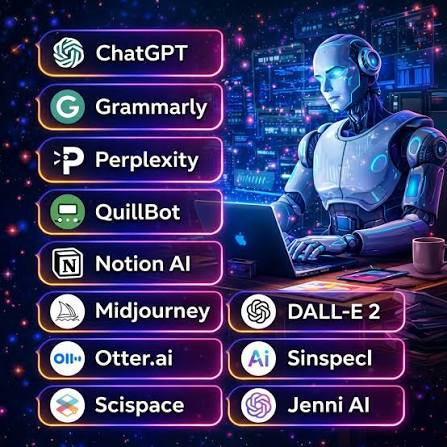
Here are some of the best AI tools helping students succeed in 2026.
ChatGPT: An All-in-One Learning Assistant
Among the most widely used AI tools is ChatGPT, which helps students answer questions, explain difficult topics, summarize lengthy articles, generate study plans, and improve writing.
Students can use ChatGPT to understand mathematics, science, programming, literature, history, economics, and many other subjects through conversational explanations. The tool can also assist with brainstorming essay ideas, practicing interview questions, learning new languages, and preparing for examinations.
Educators recommend using ChatGPT as a study companion rather than copying its responses directly into assignments.
Google Gemini Expands Research Capabilities
Google Gemini has become another powerful AI assistant for students.
The platform combines advanced language understanding with Google’s search capabilities, allowing users to research topics, summarize information, analyze documents, and generate ideas quickly.
Students working on presentations, reports, or research projects often use Gemini to organize information and simplify complex concepts.
Its integration with Google’s productivity tools also makes collaboration easier for students working on group assignments.
Microsoft Copilot Boosts Productivity
Microsoft Copilot is increasingly popular among students who regularly use Microsoft Word, Excel, PowerPoint, and Outlook.
The AI assistant can help draft essays, create presentations, summarize documents, organize spreadsheets, and generate meeting notes.
For students already using Microsoft 365, Copilot streamlines academic work by automating repetitive tasks and improving productivity across multiple applications.
Grammarly Improves Academic Writing
Writing remains one of the most important skills in education, and Grammarly continues to be a leading AI-powered writing assistant.
The platform checks grammar, spelling, punctuation, clarity, tone, and sentence structure while suggesting improvements that make writing more professional and readable.
Students preparing essays, dissertations, research papers, or scholarship applications often rely on Grammarly to polish their work before submission.
The tool also helps non-native English speakers improve their language skills over time.
Notion AI Simplifies Note-Taking
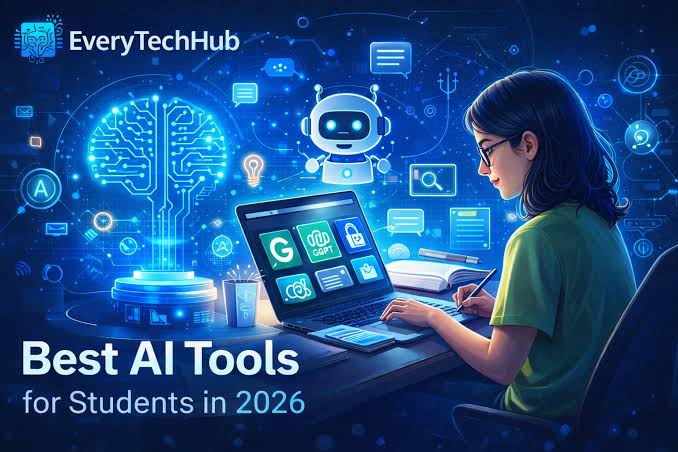
Notion AI combines note-taking, task management, and artificial intelligence in one workspace.
Students can organize lecture notes, summarize class materials, generate revision questions, create study schedules, and manage assignments more efficiently.
The platform is particularly useful for university students handling multiple courses and long-term research projects.
Its collaborative features also make it suitable for group work.
Perplexity AI Enhances Research
Perplexity AI has emerged as a favorite among students conducting research.
Unlike traditional chatbots, it provides answers alongside cited sources, helping users verify information and explore original references.
This makes it especially useful for academic research where source credibility is essential.
Students can ask detailed questions and quickly access supporting information from reputable publications.
Canva Magic Studio Makes Design Easy
Visual presentations have become an important part of education.
Canva’s AI-powered Magic Studio helps students create professional presentations, posters, infographics, resumes, and social media graphics without advanced design experience.
Its AI features generate images, suggest layouts, write content, and edit designs, making creative projects faster and easier.
Many schools and universities encourage students to use Canva for presentations and classroom assignments.
Wolfram Alpha Supports STEM Students
Students studying mathematics, engineering, chemistry, and physics frequently use Wolfram Alpha for solving equations and understanding scientific concepts.
The platform provides detailed step-by-step explanations rather than simply displaying final answers.
Its capabilities extend beyond mathematics to include statistics, economics, finance, chemistry, astronomy, and data analysis.
Many educators consider it one of the most reliable AI-powered learning resources for STEM subjects.
Quizlet AI Improves Exam Preparation
Quizlet has integrated artificial intelligence to make studying more interactive.
Students can generate flashcards automatically, take adaptive quizzes, and receive personalized study recommendations based on their learning progress.
The platform uses spaced repetition techniques to help improve long-term memory retention, making it particularly useful before examinations.
Its mobile accessibility allows students to study virtually anywhere.
Otter.ai Makes Note-Taking Effortless
Students attending lectures, seminars, or online classes often struggle to capture every important detail.
Otter.ai solves this problem by transcribing spoken lectures into searchable text in real time.
The platform automatically generates summaries and highlights key discussion points, allowing students to focus more on understanding lessons instead of writing extensive notes.
It is especially valuable for remote learning and recorded lectures.
GitHub Copilot Assists Programming Students
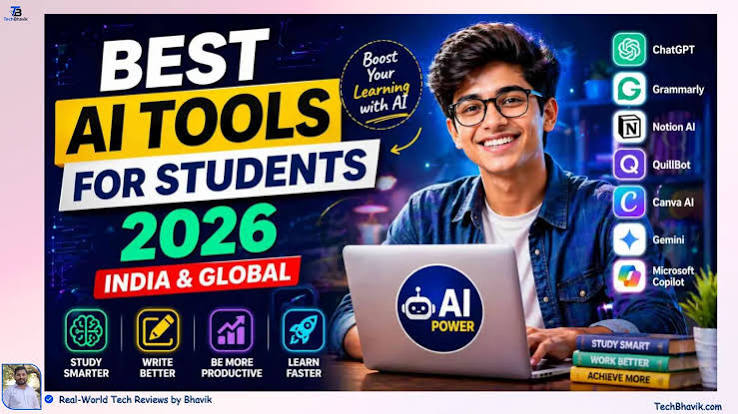
Computer science and software engineering students increasingly rely on GitHub Copilot.
The AI coding assistant suggests code, explains programming concepts, detects errors, and helps developers learn new programming languages more efficiently.
While it should not replace understanding programming fundamentals, Copilot can significantly accelerate software development and debugging.
It supports many popular programming languages, including Python, JavaScript, Java, C++, and C#.
Duolingo Max Makes Language Learning Smarter
Language learners now benefit from AI-powered tutoring through Duolingo Max.
The platform provides conversational practice, personalized feedback, pronunciation guidance, and grammar explanations.
Students studying French, Spanish, German, Chinese, and many other languages can improve their speaking, listening, reading, and writing skills through interactive lessons.
AI-powered conversations also simulate real-world communication.
Khanmigo Offers Personalized Tutoring
Khanmigo, developed by Khan Academy, functions as a virtual tutor rather than simply providing answers.
Instead of solving problems outright, it guides students through reasoning processes and encourages independent thinking.
This teaching approach aligns closely with educational best practices and supports deeper understanding across subjects including mathematics, science, history, and computer programming.
Choosing the Right AI Tool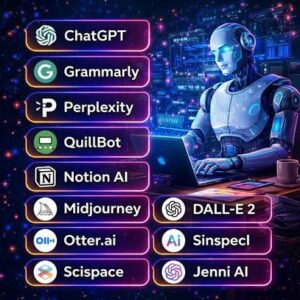
Experts advise students to select AI tools based on their specific academic needs.
For writing assignments, Grammarly and ChatGPT remain excellent choices.
Students conducting research may benefit more from Perplexity AI or Google Gemini.
Those studying programming can gain significant advantages from GitHub Copilot, while STEM students often find Wolfram Alpha indispensable.
Organization-focused learners may prefer Notion AI, whereas visual projects are well suited to Canva.
Using a combination of specialized tools often delivers better results than relying on a single platform.
Responsible Use of Artificial Intelligence
Although AI offers tremendous educational benefits, educators caution students against depending entirely on automated tools.
Academic integrity remains essential. AI-generated content should be reviewed carefully, verified for accuracy, and adapted using original analysis and personal understanding.
Many schools and universities now have policies governing AI use, particularly for assignments and examinations. Students are encouraged to understand these guidelines and use AI ethically.
Experts also recommend fact-checking AI-generated information with trusted academic sources, especially when preparing research papers or citing references.
The Future of AI in Education
Artificial intelligence is expected to play an even greater role in education over the coming years. Advances in personalized tutoring, adaptive learning, multilingual support, and interactive simulations are likely to make learning more accessible and engaging for students worldwide.
As AI technology continues to evolve, students who learn to use these tools responsibly will be better equipped to manage their studies, strengthen critical thinking, and prepare for the demands of higher education and the modern workplace. Rather than replacing traditional learning, AI is increasingly becoming a powerful partner that helps students learn more efficiently, solve problems with greater confidence, and achieve academic success.

