


New Delhi — India’s ambitious transition to E20 petrol, a fuel containing 20% ethanol blended with conventional gasoline, has ignited a nationwide debate as motorists, mechanics, industry experts and policymakers weigh the benefits of cleaner fuel against concerns about vehicle performance and maintenance.
The policy is part of the Indian government’s broader strategy to reduce dependence on imported crude oil, lower greenhouse gas emissions and strengthen the country’s agricultural economy by increasing demand for ethanol produced from crops such as sugarcane and maize.
While officials maintain that the transition is scientifically tested and environmentally beneficial, many owners of older vehicles say they have experienced reduced fuel economy, higher maintenance costs and uncertainty over whether their vehicles are suitable for the new fuel.
A Major Shift in India’s Fuel Policy
India began blending ethanol with petrol nearly two decades ago as part of an effort to diversify its energy sources. Over the years, the blending percentage increased gradually, reaching 10% in most parts of the country before the government accelerated its plans.
The nationwide rollout of E20 petrol marked a significant milestone in India’s biofuel programme. Instead of extending the transition over many years, authorities advanced the timeline and made the higher ethanol blend the standard fuel available at petrol stations across the country.
The government argues that the move will help India reduce billions of dollars spent annually on crude oil imports while simultaneously supporting domestic farmers through increased ethanol production.
As one of the world’s largest oil importers, India remains vulnerable to fluctuations in global energy prices and geopolitical conflicts that can disrupt supply chains. Officials believe greater ethanol production will improve energy security and reduce exposure to international market volatility.
Motorists Voice Frustration
Despite these long-term objectives, many vehicle owners have expressed frustration since E20 became the standard fuel.
Across social media platforms, motorists have shared concerns ranging from reduced mileage to fears of engine damage, particularly among owners of vehicles manufactured before ethanol-compatible engines became common.
Several drivers say they now need to refuel more frequently because ethanol contains less energy than conventional petrol, reducing the number of kilometres a vehicle can travel per litre.
For many consumers, the financial impact is particularly frustrating because E20 is generally sold at prices similar to previous petrol blends, meaning drivers pay nearly the same amount while receiving lower fuel efficiency.
The issue has become especially controversial because many motorists were unaware that conventional petrol remains available at some stations, albeit at considerably higher prices depending on the state.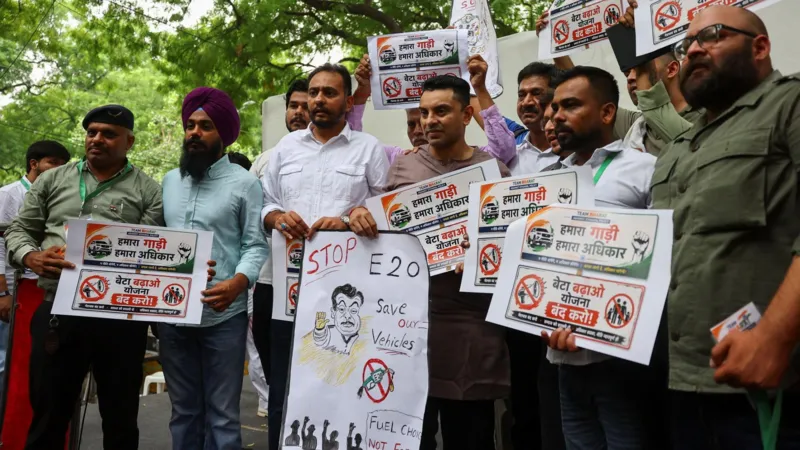
Public Demonstrations Highlight Growing Dissatisfaction
The controversy moved beyond online discussions when motorists gathered in New Delhi to protest the nationwide rollout of E20.
Participants argued that the policy had been implemented too quickly without giving consumers sufficient time to replace older vehicles or fully understand the potential implications.
Many protesters claimed they were left with little practical choice because E20 has become the default fuel at most filling stations.
Some also expressed concern about increasing maintenance expenses, saying that servicing costs have risen since switching to the higher ethanol blend.
Government Rejects Claims of Vehicle Damage
The Indian government has firmly rejected allegations that E20 damages vehicle engines.
Officials describe many of the claims circulating online as misleading and say the fuel was introduced only after years of scientific testing and consultation with automobile manufacturers.
Government agencies have launched public awareness campaigns explaining how ethanol-blended fuel works while attempting to address common misconceptions surrounding the policy.
According to officials, extensive laboratory testing and real-world vehicle trials found no evidence that E20 causes widespread mechanical failures when used under recommended conditions.
The government also emphasizes that cleaner-burning ethanol contributes to lower tailpipe emissions, helping India move closer to its climate goals.
Automakers Back the Transition
In a rare display of industry unity, several leading automobile manufacturers publicly defended the government’s biofuel initiative.
Representatives from major car companies said years of service data involving millions of vehicles had not revealed any widespread pattern of fuel-related engine failures linked to E20 petrol.
However, manufacturers acknowledged one important trade-off.
Because ethanol contains less energy than pure petrol, vehicles running on E20 typically experience a modest reduction in fuel efficiency. Industry estimates generally place the decline at around 3% to 3.5%, although some independent analysts believe losses could be higher under certain driving conditions.
Manufacturers argue that the decrease in mileage is an expected characteristic of ethanol fuel rather than evidence of mechanical damage.
Mechanics Report Mixed Experiences
Opinions among vehicle repair specialists remain divided.
Some mechanics say they have not observed any unusual increase in repairs associated with E20 fuel.
Others report servicing older vehicles that developed issues they believe may be linked to prolonged ethanol use.
Several technicians describe cleaning carburettors more frequently due to residue accumulation, while others say customers complain of declining fuel economy after switching to the new blend.
Some experts caution that ethanol absorbs moisture more readily than petrol, potentially increasing the risk of corrosion in certain fuel system components over extended periods if vehicles are poorly maintained or remain unused for long intervals.
Modern vehicles designed specifically for higher ethanol blends generally incorporate materials intended to withstand these conditions.
Older Vehicles Face Greater Uncertainty
One of the biggest challenges surrounding India’s transition is the age of its vehicle fleet.
Industry analysts estimate that a substantial majority of vehicles currently on Indian roads were originally designed for lower ethanol concentrations.
Owners of these vehicles worry that long-term exposure to E20 may gradually accelerate wear in fuel pumps, injectors, hoses and seals that were not engineered for higher ethanol content.
Automotive experts note that any potential effects are unlikely to appear immediately. Instead, they would develop gradually over thousands of kilometres and could often be minimized through regular maintenance and timely replacement of worn components.
Learning from International Experience
Countries including Brazil have successfully integrated ethanol into their transport sectors over several decades.
Brazil gradually introduced higher ethanol blends while simultaneously encouraging manufacturers to produce vehicles capable of operating on multiple fuel types. Consumers there can often choose between petrol blended with ethanol and pure ethanol depending on price and availability.
Critics argue that India’s transition occurred much faster, leaving less time for consumers and vehicle manufacturers to adapt.
Supporters counter that rapid implementation is necessary if India hopes to reduce fuel imports and meet its climate commitments within the coming decade.
Balancing Environmental Goals and Consumer Confidence
The debate surrounding E20 illustrates the complex balance governments face when pursuing cleaner energy policies.
Reducing dependence on imported fossil fuels offers clear economic and environmental advantages. Expanding ethanol production can also generate additional income for farmers while supporting domestic agriculture.
At the same time, policymakers must address legitimate consumer concerns regarding vehicle compatibility, maintenance costs and fuel economy.
Experts say greater public education, transparent long-term monitoring and continued collaboration between government agencies, automakers and independent researchers will be essential to maintaining public confidence in the programme.
As India continues its transition toward cleaner transportation fuels, the success of the E20 initiative will ultimately depend not only on environmental and economic outcomes but also on the confidence of millions of motorists who rely on their vehicles every day. Ensuring that technological progress is matched by consumer awareness and practical support will be critical as the country’s energy transition moves forward.

