


Aburi, Eastern Region — A swift and coordinated response by the Ghana National Fire Service (GNFS) prevented what could have been a devastating fire disaster at Adonten Senior High School after firefighters successfully contained a blaze that threatened to spread to the school’s science block and other key facilities.
The incident, which occurred on Saturday, saw firefighters from the Aburi and Akropong Fire Stations race against time to bring the fire under control after receiving a distress call from the school. Their rapid intervention ensured that the flames were confined to a single section of the campus, preventing extensive destruction and safeguarding critical educational infrastructure.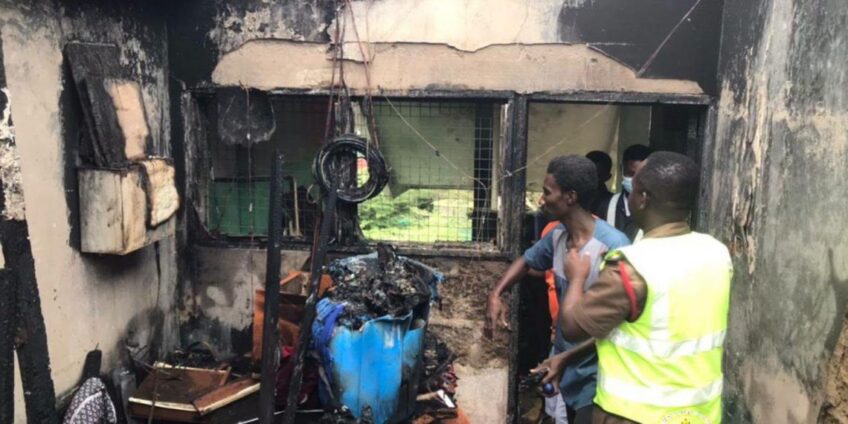
According to the Ghana National Fire Service, the fire severely damaged the housemaster’s office and an adjoining storeroom, destroying a significant quantity of school property and administrative materials. However, the firefighters’ prompt response prevented the blaze from spreading to nearby buildings, including the school’s science block, which houses valuable laboratory equipment and learning resources.
In a statement shared on its official Facebook page on Saturday, July 4, the GNFS commended the professionalism and teamwork displayed by the responding crews, describing the operation as a successful effort that significantly minimized damage.
“The fire destroyed the housemaster’s office, a storeroom, and several school properties, including office equipment, books, uniforms, and electronic appliances. However, firefighters managed to salvage library books and gardening tools while preventing the fire from extending to other structures,” the statement said.
The Service noted that firefighters from the Aburi and Akropong Fire Stations worked in close coordination upon arriving at the scene, deploying firefighting equipment and tactical measures to suppress the flames before they could engulf additional buildings.
Authorities explained that one of the major concerns during the operation was the proximity of the science block to the affected area. Had the fire reached the science laboratories, the consequences could have been far more severe due to the presence of chemicals, laboratory equipment, and other combustible materials commonly stored in such facilities.
Firefighters therefore focused much of their efforts on cooling surrounding structures while simultaneously attacking the flames at their source. Their timely intervention successfully prevented the fire from spreading beyond the housemaster’s office and storeroom.
Before the arrival of the Ghana National Fire Service, members of the school’s staff and some students attempted to extinguish the fire using available firefighting equipment and improvised methods. Despite their efforts, they were unable to bring the blaze under control as it continued to spread within the affected buildings.
Fortunately, all occupants of the affected area were safely evacuated, and no injuries or fatalities were recorded during the incident.
The absence of casualties has been described by emergency officials as a major relief, considering the potential risks associated with fires on school campuses where large numbers of students and staff are often present.
Although the full extent of the damage has not yet been quantified, preliminary assessments indicate that numerous administrative documents, office furniture, electronic equipment, school uniforms, books, and other educational materials were destroyed in the fire.
Among the items successfully rescued by firefighters were library books and gardening tools, which were removed from the threatened areas before the flames could reach them. Fire officers described the successful salvage operation as another example of the effectiveness of coordinated emergency response.
The Ghana National Fire Service has since launched an investigation to determine the exact cause of the fire. Fire investigators are expected to examine the scene thoroughly, assess possible ignition sources, and determine whether electrical faults, human activities, or other factors may have contributed to the outbreak.
School authorities are also conducting their own assessment to establish the total financial cost of the damage and identify resources that will need to be replaced before normal administrative operations can fully resume.
The incident has renewed public concern over fire safety in educational institutions across Ghana. In recent years, several schools have experienced fire outbreaks that have destroyed dormitories, classrooms, offices, and other essential facilities, raising questions about fire prevention measures and emergency preparedness on school campuses.
Fire safety experts continue to stress the importance of regular inspections of electrical installations, proper storage of combustible materials, installation of fire detection systems, and the availability of functional firefighting equipment in schools.
They also advocate routine fire drills and emergency response training for both students and staff to ensure occupants know how to respond quickly and safely during emergencies.
The Ghana National Fire Service has consistently encouraged educational institutions to comply with fire safety regulations by maintaining operational fire extinguishers, ensuring emergency exits remain accessible, and educating students and staff on basic fire prevention practices.
Officials say such preventive measures can significantly reduce the likelihood of fire outbreaks while minimizing potential losses when incidents occur.
The successful response at Adonten Senior High School has once again demonstrated the importance of rapid emergency intervention and inter-station collaboration in protecting lives and property.
The GNFS praised the dedication and professionalism of firefighters from the Aburi and Akropong Fire Stations, whose coordinated efforts ensured that the fire was quickly contained before it could escalate into a larger disaster.
As investigations continue, authorities have assured the public that findings regarding the cause of the fire will be made available once examinations have been completed.
Meanwhile, school administrators are expected to work closely with education authorities to restore the damaged facilities and replace destroyed learning materials to ensure that academic activities continue with minimal disruption.
The latest fire incident serves as a reminder of the need for continuous investment in fire safety infrastructure across educational institutions. Stakeholders have called for stronger enforcement of fire safety regulations, improved emergency preparedness, and regular risk assessments to protect schools from similar incidents in the future.
While the destruction of the housemaster’s office and storeroom represents a significant setback for the school, the successful containment of the fire prevented what could have become one of the most serious school fire disasters in the area.

