


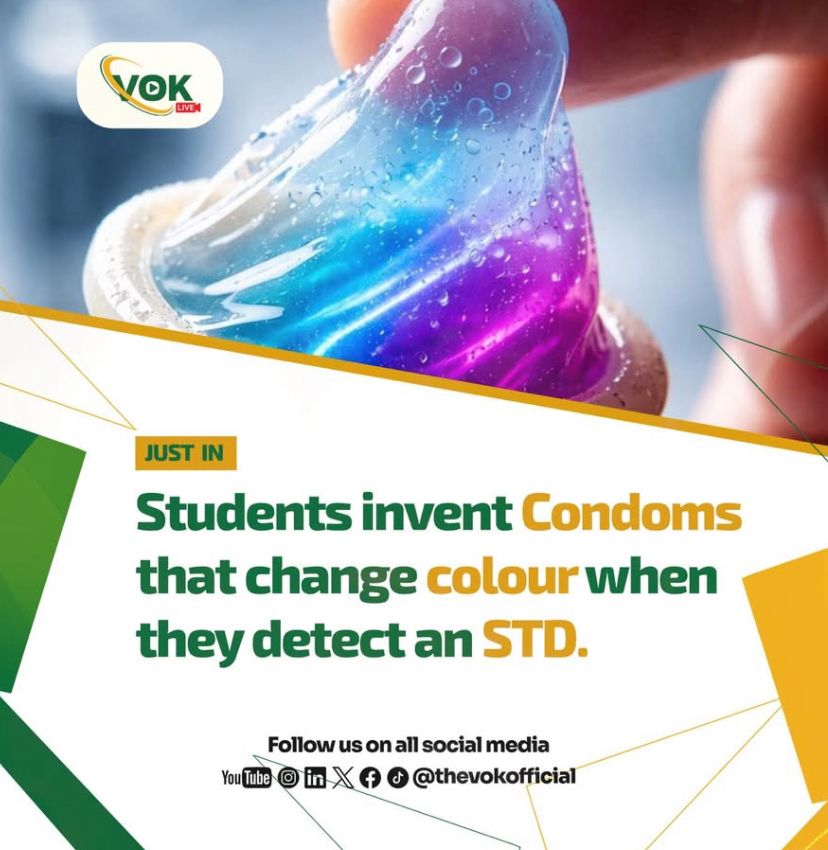
Students Claim Breakthrough with Color-Changing Condoms That Detect STDs**
*By Staff Reporter*
A group of university students has drawn global attention after unveiling a prototype condom that reportedly changes color when it comes into contact with certain sexually transmitted infections (STIs). The innovation, which the students say is still in development, aims to encourage safer sexual practices and increase awareness about sexual health.
The announcement has sparked widespread interest on social media and across health communities. Supporters describe the concept as a creative approach to promoting sexual health awareness, while medical professionals urge caution, emphasizing the importance of verified clinical testing before any such product reaches consumers.
—
### The Concept Behind the Innovation
According to the student team, the proposed condom contains a special chemical layer that reacts to specific proteins commonly associated with certain STIs. When a reaction occurs, the condom’s surface changes color, potentially alerting users to the presence of an infection.
The students explain that the concept is designed to be educational and preventative rather than diagnostic. They emphasize that the product would not replace medical testing but could encourage individuals to seek professional screening if a color change occurs.
Experts note that while the idea is intriguing, STI detection typically requires laboratory-based tests, including blood samples, urine samples, or swabs analyzed under controlled conditions. Translating that kind of testing into a consumer product presents scientific and regulatory challenges.
—
### Understanding Sexually Transmitted Infections
Sexually transmitted infections, commonly referred to as STIs, are infections that are primarily spread through sexual contact. They can be caused by bacteria, viruses, or parasites. Some of the most common STIs include chlamydia, gonorrhea, syphilis, and HIV.
Many STIs do not present noticeable symptoms in their early stages, making regular medical testing a crucial component of sexual health. Health professionals emphasize that early detection and treatment are key to preventing complications and reducing transmission.
If proven effective and safe, innovations that promote awareness about STIs could play a role in encouraging more proactive health behaviors. However, medical experts stress that no consumer product should be considered a substitute for professional healthcare advice or laboratory testing.
—
### How the Technology Is Said to Work
The students describe their prototype as incorporating a reactive layer embedded into the condom material. This layer allegedly contains molecules that bind to specific markers associated with certain infections. If a reaction occurs, a visible color shift would appear on the surface.
Such technology would rely on biosensors — devices that detect biological molecules. Biosensors are already used in medical diagnostics, such as glucose monitors for diabetes management. However, adapting these sensors to function reliably and safely in a condom presents significant engineering hurdles.
Medical researchers point out that bodily fluids contain a complex mixture of proteins and substances. Designing a sensor that accurately distinguishes infection markers without producing false positives or false negatives would require extensive validation.
—
### Public Reaction
Since images and claims about the product began circulating online, the reaction has been mixed. Many users have praised the creativity behind the idea, suggesting it could reduce stigma and encourage conversations about sexual health.
Others have raised concerns about privacy, accuracy, and potential misuse. Some critics question whether individuals might rely solely on such a product rather than pursuing comprehensive testing.
Public health organizations have responded cautiously, reminding the public that regular testing, open communication with partners, and consistent condom use remain the most reliable strategies for reducing STI risk.
—
### Regulatory and Safety Considerations
Before any medical-related product can reach the market, it must undergo thorough safety and efficacy testing. Regulatory agencies require clinical trials and scientific validation to ensure that products perform as claimed and do not pose unintended risks.
If a color-changing condom were to be marketed as a diagnostic tool, it would likely face stringent medical device regulations. Even if positioned as an awareness tool, manufacturers would need to demonstrate that it does not compromise the structural integrity or protective function of the condom.
Condoms are already regulated medical devices in many countries. They must meet strict standards for durability, elasticity, and effectiveness in preventing pregnancy and the transmission of infections. Adding a chemical detection layer could complicate manufacturing and regulatory approval processes.
—
### Experts Weigh In
Medical professionals emphasize that while innovation in sexual health technology is welcome, scientific rigor is essential. They caution against interpreting early-stage concepts as ready-for-market solutions.
Infectious disease specialists note that many STIs cannot be detected instantly upon contact. Some infections require time to establish in the body before detectable markers are present. Therefore, a real-time detection mechanism may not capture every case.
Researchers also highlight the psychological implications. A color change during intimate activity could cause distress or conflict if misinterpreted. Clear educational materials and proper guidance would be necessary if such a product were ever commercialized.
—
### The Importance of Testing and Communication
Regardless of technological advances, healthcare professionals stress that regular STI screening remains essential. Many clinics offer confidential testing services, and early treatment can prevent long-term health complications.
Open communication between partners is another cornerstone of sexual health. Discussing testing history, protection methods, and boundaries can reduce risk and build trust.
Condoms, when used correctly, remain one of the most effective methods for reducing the transmission of many STIs. However, no method offers 100% protection. Comprehensive strategies — including vaccination where available, routine screening, and informed decision-making — provide the strongest defense.
—
### Challenges Ahead
Transforming a student concept into a viable commercial product would require collaboration between scientists, medical professionals, manufacturers, and regulators. Key challenges include:
* Ensuring accurate detection without false readings
* Maintaining condom strength and reliability
* Securing regulatory approval
* Educating consumers about appropriate use
* Protecting user privacy and confidentiality
Funding and partnerships would also play a critical role. Research and development in medical technology can be costly and time-consuming.
—
### Encouraging Innovation in Health Technology
Despite uncertainties, many observers view the students’ concept as a reminder of the importance of innovation in public health. Creative approaches can spark dialogue and inspire further research.
Advances in wearable technology, at-home diagnostic kits, and telemedicine have already transformed aspects of healthcare. Continued research may lead to new tools that complement traditional testing methods.
However, experts stress that claims about health-related products should always be evaluated through peer-reviewed research and regulatory oversight.
—
### Avoiding Misinformation
In the age of social media, health-related stories can spread rapidly. It is important for readers to verify information through reputable sources and consult healthcare professionals for personalized advice.
Images and headlines may generate excitement, but scientific validation requires controlled studies and independent review. Consumers should approach unverified health claims with caution.
—
### Looking Ahead
The student team has reportedly expressed interest in refining their concept and collaborating with scientific institutions for further research. Whether the idea progresses beyond the prototype stage remains to be seen.
For now, health experts reiterate key recommendations:
* Use protection consistently and correctly
* Get tested regularly for STIs
* Seek medical advice if you suspect exposure
* Communicate openly with partners
Technological innovation has the potential to support public health goals, but it must be grounded in evidence and safety standards.
—
### Conclusion
The proposal of a condom that changes color upon detecting certain STIs has captured public imagination and ignited discussion about sexual health innovation. While the concept reflects creativity and a desire to address important health issues, significant scientific and regulatory steps would be required before such a product could become widely available.
In the meantime, established methods — including regular medical testing, vaccination, and responsible protective practices — remain the foundation of sexual health.
As with all emerging health technologies, careful evaluation, clinical testing, and transparent communication will determine whether this concept becomes a practical tool or remains an intriguing idea.

