


The Government of Ghana has announced a downward adjustment in the producer price of cocoa for the remainder of the 2025/2026 crop season, citing a significant downturn in global market prices and increasing financial strain within the cocoa sector. The revised rates set the price at GH¢41,392 per tonne and GH¢2,587 per 64-kilogramme bag, reflecting what officials describe as the difficult but necessary response to prevailing international market conditions.
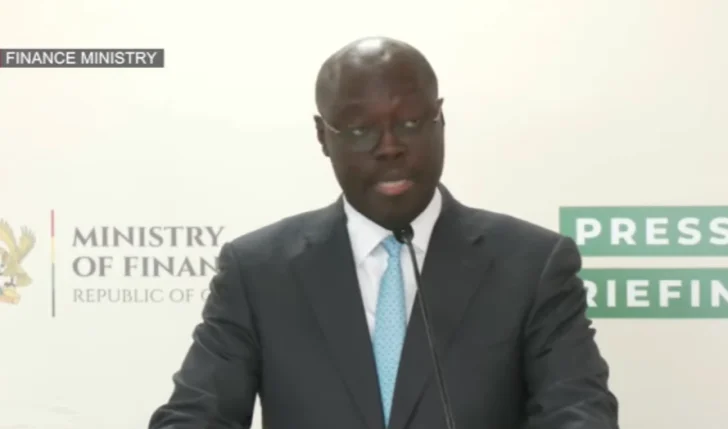
The announcement was made at a press briefing in Accra on Thursday, February 12, 2026, by the Finance Minister, Dr. Cassiel Ato Forson. He explained that the decision was taken after careful consideration of global price movements and their impact on Ghana’s cocoa industry. According to him, while the government remains committed to safeguarding farmers’ livelihoods, it must also ensure that the sector remains financially sustainable in the face of falling export revenues.
At the start of the 2025/2026 cocoa season in August 2025, the producer price had been set at GH¢51,660 per tonne. This figure was based on 70 percent of a projected gross free-on-board (FOB) price of 7,200 US dollars per tonne. The calculation at the time used an exchange rate of 10.25 Ghana cedis to one US dollar. That pricing structure was intended to offer farmers a competitive and attractive return, while aligning with international price expectations.
However, developments later in the year prompted a reassessment. In October 2025, Côte d’Ivoire, Ghana’s main competitor in cocoa production, announced an increase in its own producer price. Combined with shifts in the exchange rate, this move raised concerns about the risk of cocoa smuggling across borders, as farmers might be tempted to sell their produce where prices were more favourable. To address this threat and maintain competitiveness, Ghana responded by raising its farm gate price to GH¢58,000 per tonne, equivalent to GH¢3,625 per bag.
Dr. Forson recalled that the decision to increase the price at that time, which was endorsed by the Producer Price Review Committee (PPRC), succeeded in stabilising the situation. The upward adjustment helped align Ghana’s farm gate price with that of neighbouring countries and effectively reduced the potential for smuggling cocoa beans out of the country. By making the local price more competitive, the government was able to protect both farmers’ incomes and national export volumes.
Unfortunately, the global cocoa market began to deteriorate soon after. From October 2025 onward, international prices experienced a sharp and sustained decline. The average world market price, which had previously hovered around 7,200 US dollars per tonne, fell dramatically to approximately 4,100 US dollars per tonne. This steep drop created a mismatch between Ghana’s relatively high producer price and the much lower prices being realised on the international market.
According to the Finance Minister, the rapid fall in global prices made Ghana’s cocoa comparatively expensive and therefore less competitive on the export market. At the same time, it placed severe pressure on the finances of the Ghana Cocoa Board (COCOBOD), which is responsible for purchasing, marketing, and exporting the country’s cocoa. The disparity between the high domestic producer price and declining international revenues led to significant liquidity challenges, affecting the ability to meet financial obligations promptly.
Dr. Forson emphasised that the situation was unsustainable. If the government had maintained the October 2025 producer price in the face of falling global prices, COCOBOD’s financial position would have deteriorated further. This, in turn, could have disrupted payments to farmers and threatened the long-term viability of the sector. He stressed that the decision to reduce the price was not taken lightly but was deemed essential to restore balance and stability.
In light of these developments, the Producer Price Review Committee convened under the minister’s leadership to evaluate the situation and determine an appropriate course of action for the remainder of the season. After extensive deliberations, the committee recommended a new pricing formula designed to cushion farmers as much as possible while reflecting the new global realities.
To mitigate the adverse impact of the international price decline, the committee proposed that farmers receive 90 percent of the achieved gross FOB price, which was now estimated at 4,200 US dollars per tonne. This represented a deliberate policy choice to go beyond the statutory minimum producer share of 70 percent of export earnings. By allocating a larger proportion of export revenue to farmers, the government aimed to soften the blow of the unavoidable price reduction.
Based on this revised calculation, the new producer price was set at GH¢41,392 per tonne, translating into GH¢2,587 per 64-kilogramme bag. The adjustment took immediate effect on Thursday, February 12, 2026, and will apply for the remainder of the 2025/2026 crop season.
The new rates represent a substantial reduction from the October 2025 figures. Specifically, the price per tonne has decreased by GH¢16,608, while the price per bag has fallen by GH¢1,038. This marks a significant reversal from the earlier increase, underscoring the volatility that has characterised the global cocoa market over the past several months.
Dr. Forson acknowledged that the reduction would be difficult for farmers, many of whom depend heavily on cocoa as their primary source of income. He noted, however, that maintaining the previous price in the face of sharply reduced export revenues would have jeopardised the sector’s financial health and could ultimately have harmed farmers even more severely. The revised price, he argued, strikes a necessary balance between supporting farmers and ensuring the sustainability of the cocoa industry.
He explained that aligning the producer price more closely with international market conditions would help restore competitiveness and improve cash flow within the sector. By reducing the financial strain on COCOBOD, the government expects to facilitate quicker payments to farmers and other stakeholders, thereby addressing some of the liquidity constraints that have emerged in recent months.
The minister further highlighted that, despite the reduction, the government has chosen to maintain a high producer share of export earnings. Paying farmers 90 percent of the achieved gross FOB price is significantly above the statutory threshold of 70 percent. This policy decision reflects the government’s stated commitment to prioritising farmers’ welfare even in challenging economic circumstances.
In his closing remarks, Dr. Forson expressed appreciation for the resilience and patience demonstrated by Ghanaian cocoa farmers over the years. He acknowledged the strain that price volatility and broader economic pressures have placed on growers and other participants in the value chain. Nonetheless, he conveyed confidence that ongoing reforms within the cocoa sector would strengthen its foundations and deliver long-term benefits.
According to the minister, the current adjustment forms part of a broader reform agenda aimed at transforming the cocoa industry. These reforms are intended to enhance efficiency, improve financial management, and increase value addition within the sector. By addressing structural weaknesses and aligning domestic policies with global market realities, the government believes it can build a more resilient and competitive cocoa industry.
He reiterated that the overriding objective is to protect the interests of cocoa farmers while safeguarding the sustainability of the sector as a whole. Although the immediate reduction in the producer price may be painful, officials argue that it is a necessary step to prevent deeper financial instability and to ensure that the industry remains viable in the long term.
The recent developments illustrate the vulnerability of commodity-dependent economies to fluctuations in global markets. Ghana, as one of the world’s leading cocoa producers, is particularly exposed to changes in international prices. When prices are high, farmers and the broader economy benefit from increased export earnings. Conversely, when prices fall sharply, as they have in recent months, difficult adjustments become unavoidable.
In this context, the government’s decision reflects an attempt to navigate a complex and rapidly changing global environment. By recalibrating the producer price to reflect current market conditions, while maintaining a generous share of export revenues for farmers, policymakers aim to strike a delicate balance between economic realism and social responsibility.
Ultimately, the success of this approach will depend on how global cocoa prices evolve in the coming months and on the effectiveness of the broader reform programme. For now, the government maintains that the revised producer price is a necessary and prudent response to unprecedented market pressures. While acknowledging the sacrifices required, officials remain optimistic that the measures taken will stabilise the sector and lay the groundwork for a more sustainable and prosperous future for Ghana’s cocoa industry.

