


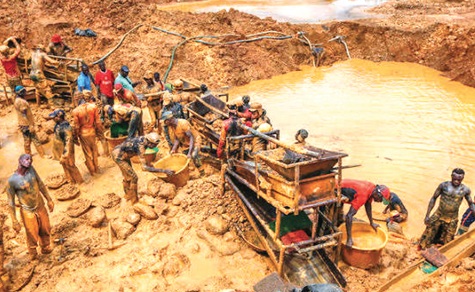
In Nine Years in the Gold Coast, published in London in 1898, the British missionary Reverend Dennis Kemp provides one of the earliest written accounts of indigenous gold mining in what is today Ghana. Writing from the perspective of a 19th-century European observer, Kemp describes traditional, small-scale gold washing and mining practices carried out by local communities long before the advent of industrial extraction. While his language reflects the colonial prejudices of his era—he repeatedly characterises indigenous methods as “primitive”—his observations are nevertheless revealing.
Kemp contrasts local mining practices with what he calls “modern” European techniques, which had only just begun to take root in the Gold Coast in 1897. He notes the environmental disturbance caused by indigenous mining, yet his account makes clear that these activities were small-scale, informal, and largely unregulated. Crucially, they coexisted with the early stages of industrial mining, which would later prove far more environmentally destructive. Kemp’s writings remind us that gold mining in Ghana is not a recent phenomenon, nor is environmental damage entirely new. What is new is the scale, intensity, and institutional failure surrounding illegal mining today—commonly known as galamsey.
More than seventy-five years after Kemp’s observations, galamsey had become a recognised national problem. By the time Flight Lieutenant Jerry John Rawlings seized power through a coup d’état in 1979, illegal artisanal mining was already expanding rapidly. This expansion occurred alongside rising unemployment, weak regulation, and growing corruption. According to Allotey Jacobs, a former Central Regional Chairman of the National Democratic Congress, Rawlings “couldn’t do anything about galamsey.” That assessment is striking, particularly given Rawlings’ reputation for discipline, decisiveness, and moral crusading.
Indeed, successive governments—those of Rawlings himself, John Agyekum Kufuor, John Atta Mills, Nana Akufo-Addo, and even John Dramani Mahama during his first term—have all failed to bring galamsey under control. Each administration has announced strategies, task forces, bans, and renewed commitments. None has succeeded. Today, galamsey is not merely a nuisance or an environmental concern; it is a full-blown national crisis.
Rawlings and the Paradox of Inaction
Jerry John Rawlings’ failure to confront galamsey decisively is puzzling. His political record suggests he was uniquely positioned to act. Rawlings ruled with an iron hand during the early years of the Provisional National Defence Council (PNDC), enforcing discipline through drastic and often brutal measures. His government executed former heads of state for corruption, detained political opponents, and projected a strong pro-environment and anti-corruption stance. Rawlings frequently spoke about moral decay, national discipline, and the need to protect Ghana’s future.
Why, then, did he not apply the same uncompromising approach to galamsey?
One plausible explanation is political economy. Galamsey, even then, was embedded in local livelihoods and informal power structures. It employed thousands of young men with limited education and few alternatives in an economy struggling to absorb its growing youth population. A sudden, militarised crackdown could have generated widespread unrest, particularly in rural areas already alienated from central authority.
Yet Rawlings was not known for shying away from unpopular decisions. He believed in swift, decisive action rather than slow bureaucratic reform. Had he chosen to confront galamsey head-on, he could have deployed the Ghana Armed Forces to shut down illegal mining sites, seize and destroy equipment, and prosecute offenders publicly. He could have acted forcefully against foreign involvement, particularly from Chinese nationals, whom he later accused of destroying Ghana’s rivers and forests with the assistance of corrupt locals.
Rawlings frequently expressed anger at foreign exploitation of Ghana’s resources and at Ghanaians who enabled it. He argued that foreigners caught engaging in environmental destruction should be deported and that Ghanaians collaborating with them should face severe punishment. He also recognised the role of corruption within the security services, which allows galamsey to operate with impunity. A determined effort to purge complicit officials might have significantly disrupted illegal mining networks.
That none of this happened suggests a deeper constraint: galamsey was already benefiting powerful interests. Even a revolutionary leader may hesitate when the beneficiaries of illegality include political allies, financiers, traditional authorities, and elements within the state itself.
Galamsey and the Structure of Society
Today, galamsey continues to thrive, despite repeated pledges to eliminate it. Rivers have turned brown and poisonous, farmlands have been rendered useless, forests have been stripped bare, and entire communities have lost access to clean drinking water. The environmental devastation is undeniable, and its social consequences are profound. Livelihoods based on farming and fishing have collapsed, health outcomes have worsened, and rural poverty has deepened.
Yet the political response remains weak. One explanation often offered is geographical distance. Ghana’s political and economic elites largely reside in Accra, a city untouched by galamsey. The capital does not suffer from contaminated rivers, abandoned pits, or poisoned farmland. Tap water in Accra remains safe to drink. The destruction occurs elsewhere—out of sight, and therefore, for many decision-makers, out of mind.
However, this explanation is insufficient. Galamsey does attract public condemnation. Politicians, chiefs, pastors, and imams routinely denounce it. Governments proudly announce arrests, equipment seizures, and temporary victories. Small-scale miners—the visible, expendable foot soldiers—are paraded as evidence of action.
But these miners are not the real beneficiaries. They are mostly young men, unemployed or underemployed, with few viable alternatives in an economy that has failed to generate sufficient decent jobs. They take enormous personal risks, working in dangerous conditions for modest returns. When arrested, they are easily replaced.
The real power lies elsewhere.
Following the Gold
At the heart of galamsey is money—specifically, gold prices that remain historically high. On Monday, February 2, gold traded at $4,750 an ounce, down from $5,400 the previous week. Despite short-term fluctuations, gold prices remain elevated due to geopolitical instability, strong central bank demand, and a weakened US dollar. Some technical analyses even suggest further gains.
High prices create powerful incentives. Illegally mined gold from Ghana is rarely sold domestically through official channels. Instead, it moves through sophisticated smuggling networks. Local buyers purchase gold near mining sites, often paying cash. These traders aggregate the gold and transport it across borders—commonly through Togo and Burkina Faso—avoiding taxes, royalties, and regulatory scrutiny.
From there, the gold is exported to international destinations, particularly the United Arab Emirates (notably Dubai) and India. China is also believed to be a destination. Once abroad, the gold is refined and mixed with legally sourced gold, effectively laundering its illicit origins. By the time it enters global supply chains, it is impossible to trace back to a specific illegal mine in Ghana. It may reappear as jewellery in Indian markets or as bullion held by international institutions.
This system cannot function without protection. Corruption lubricates every stage—from local officials who look the other way, to security personnel who facilitate transport, to elites who finance operations and profit from exports. Galamsey survives not because the state is unaware of it, but because parts of the state benefit from it.
Governance Failure, Not Policy Failure
The persistence of galamsey is often framed as a policy problem. Governments announce new task forces, bans on small-scale mining, or initiatives to formalise artisanal miners. These measures fail because galamsey is not primarily a technical issue. It is a governance failure.
Environmental protection in Ghana is not a genuine priority. It is a slogan, deployed when politically convenient, then quietly abandoned. Laws exist. Institutions exist. Knowledge exists. What is missing is political will—particularly the willingness to confront powerful interests, including those within the ruling class.
Until environmental destruction carries real political and personal consequences for decision-makers, nothing will change. Until benefiting from galamsey becomes more costly than stopping it, the destruction will continue. Until youth unemployment is addressed meaningfully, young men will keep digging. Until corruption is punished consistently, officials will keep colluding.
Galamsey is not merely ripping gold from the earth. It is ripping the life out of Ghana’s once green and fertile land, poisoning its waters, and hollowing out its institutions.
The tragedy is not that Ghana lacks solutions. The tragedy is that too many people in positions of power profit from the problem.
The writer is Emeritus Professor of Politics, London Metropolitan University, UK.

