


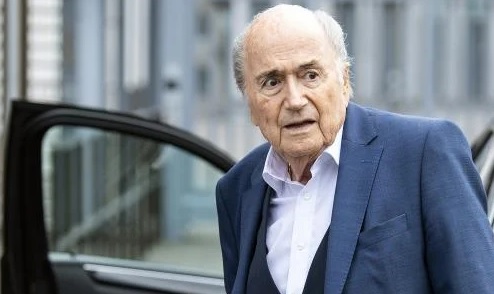
Former FIFA president Sepp Blatter has reignited global debate around football governance, ethics, and political influence in sport after publicly backing calls for fans, officials, and stakeholders to “, citing deep concerns about the direction of global football and the values it currently represents.
Blatter’s remarks, coming from a man who once stood at the very centre of world football power, have carried particular weight. Though controversial and often polarising, the former FIFA boss remains one of the most influential figures in the history of the sport. His decision to support a boycott—symbolic or practical—marks a dramatic shift from his long-held belief in football as a unifying global force.
A Stunning Intervention from a Former Power Broker
Sepp Blatter led FIFA for 17 years, from 1998 until 2015, overseeing unprecedented commercial growth, World Cup expansion, and football’s transformation into a multi-billion-dollar global industry. His tenure, however, ended in scandal, with corruption allegations that shook FIFA to its core and permanently altered public trust in football’s governing bodies.
Now, years after his departure from office, Blatter has positioned himself as a critic of the system he once helped build. His endorsement of calls to “stay away” from the World Cup reflects deep frustration with what he describes as football’s moral decline and increasing capture by political and commercial interests.
According to Blatter, the World Cup—once a celebration of sporting excellence, cultural exchange, and unity—has become a tool shaped by power politics, financial influence, and governance failures. He argued that walking away, even symbolically, may be one of the few remaining ways to force meaningful reform.
What Does “Stay Away” Mean?
Blatter was careful to clarify that his support for staying away from the World Cup does not necessarily call for players to abandon their dreams or fans to permanently disengage from football. Rather, he framed the idea as a protest against systems, not the sport itself.
In his view, selective boycotts—by sponsors, officials, dignitaries, or even national associations—can serve as powerful statements when institutions fail to uphold ethical standards. He compared such actions to historical sports boycotts that were used to challenge injustice, corruption, or political abuse.
“Football must send a message,” Blatter suggested. “If the system refuses to listen, then absence speaks louder than presence.”
Ethics, Governance, and the Soul of Football
At the heart of Blatter’s argument is a belief that football has lost its moral compass. He criticised what he sees as weak governance structures within FIFA and other football bodies, arguing that reforms introduced after his exit have not gone far enough.
Blatter contended that modern football is increasingly shaped by powerful states, corporate interests, and political agendas that conflict with the sport’s core values. In this environment, he said, decisions about World Cup hosting, tournament organisation, and commercial partnerships often prioritise money and influence over transparency, fairness, and human dignity.
He also expressed concern about the widening gap between football’s elite and grassroots levels, noting that while World Cups generate enormous revenue, many local football communities around the world continue to struggle for funding and support.
Human Rights and the World Cup Debate
Blatter’s comments align with broader global criticism that has surrounded recent and upcoming World Cups. Human rights organisations, labour activists, and civil society groups have repeatedly raised concerns about working conditions, freedom of expression, treatment of minorities, and the political use of mega-sporting events.
While Blatter stopped short of naming specific countries in his most recent remarks, his support for staying away from the World Cup has been widely interpreted as an endorsement of protests against hosts accused of rights violations or governance shortcomings.
He argued that football cannot claim neutrality when its biggest events are intertwined with political power and human consequences. “You cannot separate football from society,” Blatter said. “If society is harmed, football shares responsibility.”
Critics Question Blatter’s Credibility
Unsurprisingly, Blatter’s intervention has drawn sharp criticism from some quarters. Detractors argue that his moral stance rings hollow, given FIFA’s corruption scandals during his presidency. They accuse him of attempting to rewrite history or reposition himself as a reformer after presiding over an era widely associated with ethical failure.
Some critics have also questioned whether Blatter’s call to stay away from the World Cup is realistic or effective, noting that fans and players often bear the emotional cost of boycotts, while powerful institutions remain largely untouched.
Others argue that football’s global popularity makes large-scale boycotts unlikely, especially among supporters for whom the World Cup represents a rare moment of national pride and joy.
Supporters Say His Voice Still Matters
Despite these criticisms, Blatter has also found unexpected support. Some football commentators and activists argue that his insider knowledge gives his warnings credibility, even if his past is controversial.
They suggest that Blatter’s remarks should be viewed less as a moral lecture and more as a confession from within the system—an admission that football’s governance problems are deeper and more entrenched than many are willing to acknowledge.
To these supporters, Blatter’s call to stay away from the World Cup reflects not hypocrisy, but regret—and a desire to spark overdue conversations about reform.
The Power of Absence in Sport
Historically, boycotts and withdrawals have played a significant role in shaping sports politics. From Olympic boycotts during the Cold War to sanctions against apartheid-era South Africa, absence has often been used as a tool to challenge injustice and force change.
Blatter drew on this history to argue that football should not be exempt from ethical accountability. He suggested that even partial disengagement—such as political leaders refusing to attend matches, sponsors reconsidering partnerships, or associations publicly protesting—can shift public discourse and pressure governing bodies.
However, he acknowledged that such actions require coordination, courage, and a willingness to sacrifice short-term benefits for long-term integrity.
FIFA’s Position and the Future of the World Cup
FIFA has consistently rejected calls for boycotts, maintaining that football should remain politically neutral and inclusive. The organisation argues that the World Cup brings people together, promotes dialogue, and can even drive positive change in host countries.
FIFA officials often emphasise reforms introduced in recent years, including updated bidding processes, human rights frameworks, and compliance mechanisms. They contend that engagement, rather than withdrawal, is the most effective way to influence progress.
Blatter, however, remains sceptical. He argues that without stronger enforcement and genuine accountability, such reforms risk becoming symbolic gestures rather than transformative change.
Fans Caught in the Middle
One of the most complex aspects of the debate is the role of fans. For millions of supporters around the world, the World Cup is not a political statement but a deeply emotional event tied to identity, memory, and belonging.
Blatter acknowledged this tension, admitting that asking fans to stay away is “painful and difficult.” Yet he insisted that fans also have power—and that their choices matter.
“Football belongs to the people,” he said. “If the people withdraw their support, even temporarily, the system will feel it.”
A Legacy Still Being Written
Sepp Blatter’s backing of calls to stay away from the World Cup adds a surprising chapter to his long and complex legacy. Once the ultimate football insider, he now speaks as a critic from the margins—both shaped by and distanced from the institution he led.
Whether his words lead to action remains uncertain. What is clear, however, is that they have reopened fundamental questions about football’s purpose, governance, and moral responsibility in a globalised world.
Conclusion
Blatter’s endorsement of a World Cup boycott is less about a single tournament and more about the future of football itself. It challenges fans, players, sponsors, and officials to reflect on what they are willing to accept—and what lines should not be crossed in the pursuit of entertainment and profit.
In supporting calls to “stay away,” the former FIFA president has reignited debate about whether football can truly claim to unite the world while ignoring the systems and values that shape it. Love him or loathe him, Sepp Blatter has once again forced the football world to confront uncomfortable truths—and to decide whether the beautiful game can still live up to its name.

